ERP vs. accounting software: A CFO's guide to scaling

Key takeaways:
- Accounting software handles single-entity financials well, but hits its ceiling with multi-entity consolidation, where manual reconciliation becomes the constraint.
- The clearest signs it's time for an ERP: a close cycle driven by manual work, climbing legacy support costs, and audit prep that takes too long.
- ERP systems absorb entity growth without added overhead. Businesses that switch have cut close cycles by more than half.
- Staying on legacy has real costs in staff hours, audit exposure, and fees. A phased rollout gets finance teams to operational on a predictable timeline.
Nearly 6 in 10 finance leaders surveyed by Forrester report data fragmentation across their financial systems. Manual reconciliations to fix these gaps create bottlenecks that slow reporting and limit the CFO's ability to act on current numbers.
An AI-native ERP, like Intuit Enterprise Suite, is built for businesses that have outgrown standalone accounting software. It combines an enterprise-grade financial core with multi-entity consolidation and 850+ integrations.
Below, we break down the key differences between ERP and accounting software, the signs that it's time to move on from a legacy system, and what to look for when you make the switch.
What are ERP systems?
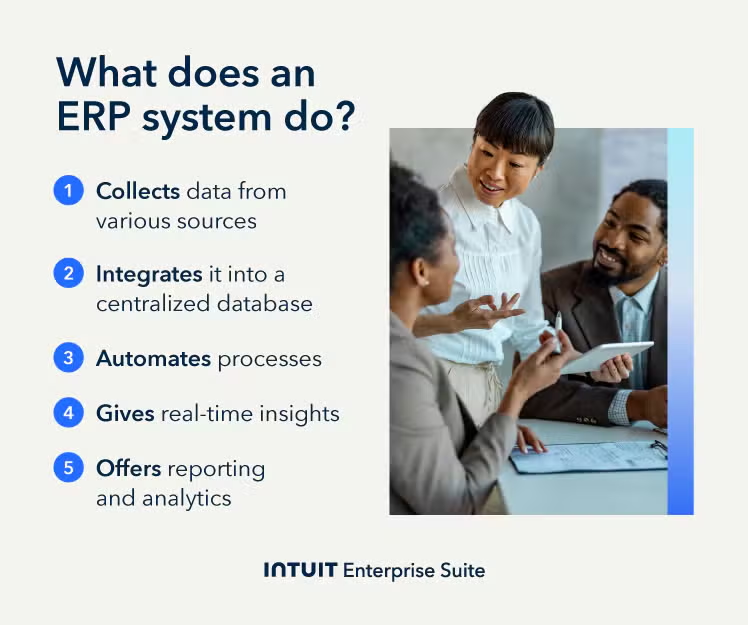
Enterprise resource planning (ERP) systems integrate finance, operations, and HR into a single platform, giving finance leaders one consolidated view instead of stitching together separate tools. For multi-entity businesses, that consolidation is the core value: rather than manually reconciling books across subsidiaries, an ERP treats every entity as part of one financial structure, with intercompany eliminations, consolidated reporting, and role-based access built in.
Modern ERPs are also cloud-native and AI-enabled, so consolidated financials stay current across every entity without batch exports, and forecasting, anomaly detection, and close automation run well ahead of what legacy systems can do.
What is accounting software?
Accounting software automates core financial tasks, like general ledger, AR/AP, bank reconciliation, payroll, and reporting, for a single entity. It handles those fundamentals well until a business adds entities or needs reporting that spans subsidiaries, at which point consolidations require manual exports and intercompany transactions have no native home.
That's the point where most finance leaders first feel the cost of staying on a single-entity system: support fees climb, workarounds multiply, and reconciliation time starts showing up directly in the close cycle.
Types of accounting software
Accounting software generally falls into three tiers. Basic solutions cover invoicing and expense tracking and are suited to single-entity businesses with straightforward financials. Mid-range solutions add inventory management and payroll and work for small to mid-sized businesses with moderate complexity.
Enterprise accounting software sits at the top of that range, built for more complex financial processes with the reporting depth and security controls that growing businesses need. As a business adds locations, entities, or subsidiaries, that same enterprise-grade foundation scales with it.

ERP vs. accounting software: Key differences
Both ERP systems and accounting software can support financial management, but they're built for different levels of complexity. For businesses managing multiple entities, the differences compound quickly.
Scope and integration
Accounting software focuses on financial management within a single entity. It can connect to other financial tools, but those integrations are limited and typically require manual data transfers to produce a consolidated view.
ERP systems are built around a centralized data model that spans every business function, from finance and payroll to operations and project management, giving finance leaders a single source of truth across the entire organization rather than a patchwork of connected tools.
Scalability and customization
Accounting software has a defined ceiling. Adding an entity typically means adding another instance, another login, and another manual reconciliation workflow. ERP systems are designed to absorb growth, whether that means a new subsidiary, a new location, or a new line of business, without a corresponding increase in administrative overhead.
For businesses growing through acquisition, the difference is significant. For example, Rhodes Companies managed nine separate sets of books before consolidating onto a single platform, with reporting that was entirely manual and a close process that reflected it.
Lango faced the same problem across seven acquired entities, with the accounting team losing 25 to 30% of their weekly capacity just reconciling spreadsheets before moving to a unified platform.
Industry-specific solutions
Accounting software is largely generic across industries, with limited ability to accommodate the reporting, compliance, or operational requirements of specific verticals. ERP systems can be customized for industry-specific needs, adding modules for job costing in construction, fund accounting in nonprofit, or project-based revenue recognition in professional services.
Lallier Construction, for example, reclaimed 90% of their accounting cycle after moving to a platform built to handle the complexity of construction financials across multiple projects and entities simultaneously.
Compliance and reporting
Accounting software generates standard financial reports and supports basic financial compliance. It doesn't accommodate the audit trail requirements, role-based access controls, or intercompany governance that multi-entity businesses need to stay audit-ready.
ERP systems support comprehensive compliance requirements, including GAAP-aligned reporting, SOC-1 controls, and the kind of preparer and approver documentation that auditors expect across every entity.
For example, Western Companies incurred $12,000 in additional auditor fees from a single manual consolidation error before switching platforms.
Real-time data and analytics
Accounting software provides real-time data on financial transactions within a single entity, but producing a cross-entity view requires manual intervention. Analytics capabilities are limited, and any insight that requires data from outside the accounting system has to be assembled by hand.
ERP systems provide cross-entity real-time data, with forecasting tools that draw from live financials across every subsidiary. The practical difference for finance leaders is forecast accuracy. When the numbers your team is using to plan reflect the current state of the business rather than last month's export, the decisions that follow are more reliable.
Total cost of ownership (TCO)
Accounting software carries lower upfront costs, but the TCO calculation changes as the business grows. Each additional entity adds administrative overhead, each workaround adds staff time, and each manual consolidation adds risk. Support fees on legacy accounting systems also tend to climb as vendors deprioritize older platforms.
ERP systems carry higher implementation costs, but those costs buy a platform that absorbs complexity rather than compounding it. According to a Forrester study, businesses that moved to Intuit Enterprise Suite projected a 299% return on investment over three years, with $446,824 in net present value savings for a composite 10-entity firm.
Choosing between ERP and accounting software
The right choice ultimately depends on where your business is today and what your financial infrastructure needs to support over the next three to five years.
If you’re weighing the cost of a full ERP against the familiarity of your current accounting software, it’s more useful to ask which system is actually costing the company in close cycle time, staff hours, and audit exposure. That TCO calculation tends to change the framing of the decision considerably.

Hybrid approach: When to use both ERP and accounting software
A hybrid setup makes sense for businesses with uniquely specialized compliance requirements that no ERP module currently accommodates, or mid-migration organizations that are running both systems in parallel during a phased transition.
In both cases, the hybrid setup is a bridge, not a destination.
However, for most multi-entity businesses, a hybrid approach introduces more complexity than it solves. Running a separate accounting system alongside an ERP means:
- Maintaining two data sources
- Managing reconciliation between them
- Accepting that your consolidated view will depend on a manual transfer
When to choose ERP over accounting software
For multi-entity businesses, the decision to move to an ERP is rarely about wanting more features. It's usually about a specific operational failure that the current system can no longer absorb. These are the clearest triggers.

Your close cycle is driven by manual reconciliation
When finance teams spend close week pulling data from multiple systems by hand, the slow close isn't a process problem. It's a financial infrastructure problem. At Sylvia Brafman Mental Health Center, the finance team manually reconciled transactions across nine bank accounts every reporting period, checking each line to catch what got missed or duplicated. Moving intercompany accounting onto Intuit Enterprise Suite cut 20 hours a week out of that work.
You've added entities faster than your system can handle
Each acquisition that adds a new set of books, a new login, and a new reconciliation workflow is a signal that the current system wasn't built for the structure you're operating. Rhodes Companies unified nine entities and cut accounting time by 50% after consolidating onto a single platform.
Audit prep is consuming your team
Without a centralized audit trail, role-based access controls, and standardized approval workflows across entities, finance teams spend audit season assembling evidence rather than reviewing it. That's a compliance risk and a resource drain that compounds each cycle.
Your legacy system's support costs keep climbing
When vendor support fees rise year over year for a platform that stopped innovating, the TCO calculation shifts. The cost of staying starts to exceed the cost of moving, particularly when staff hours spent on workarounds are included in the total.
Your business operates in construction, manufacturing, nonprofit, or professional services
These verticals carry reporting, compliance, and project-level accounting requirements that generic accounting software wasn't built to handle. Lallier Construction reclaimed 90% of its accounting cycle after moving to a platform built for multi-entity construction financials. Four Points RV Resorts, managing eight parks across multiple LLCs, saved $100,000 annually after consolidating onto Intuit Enterprise Suite.
Boost productivity and enhance profitability
Accounting software gets businesses off the ground, but it wasn't built for multi-entity complexity. As more entities come online, manual consolidations and climbing legacy support costs turn the system itself into the constraint, and the close cycle is where that shows up first.
Intuit Enterprise Suite is built for businesses at that inflection point. It automates the manual processes slowing down your close and gives finance leaders the visibility to plan with confidence. Schedule a call to see how it can work for your team.