ERP data analysis explained: Data-based decision-making

Key takeaways:
- ERP data analysis consolidates transactional, analytical, and master data from across your organization into a single platform, giving finance teams one reliable source of truth.
- A gap analysis in an ERP context helps finance leaders identify where current system capabilities fall short of what the business actually requires.
- The three core components of ERP analytics are data extraction and transformation, centralized data warehousing, and business intelligence tools that surface actionable insights.
- For multi-entity organizations, real-time consolidated reporting is what separates reactive month-end closes from continuous, forward-looking financial management.
Finance teams at multi-entity companies spend significant time each month not on analysis, but on assembly. Pulling exports, reconciling intercompany accounts across subsidiaries, and manually consolidating reports before anyone can actually interpret them. By the time the data is clean, the window to act on it has often closed.
ERP data analysis changes that dynamic. When your enterprise resource planning (ERP) system is doing its job, data from every entity, department, and workflow flows into a single, reconciled environment. According to a commissioned Forrester TEI study, Intuit Enterprise Suite customers project a 299% ROI over three years and 74% projected savings from efficiencies in intercompany transactions alone.
This guide covers what ERP data analysis is, how gap analysis fits into the ERP evaluation process, the key components of a functional analytics setup, and how multi-entity finance teams use these capabilities to close faster and plan with greater confidence.
ERP data analytics explained
ERP data analytics is the practice of turning the information your ERP system collects, from transactions to customer interactions, into insights you can act on. Rather than treating data as a byproduct of running the business, ERP analytics uses that data to shift the focus from explaining the past to anticipating what comes next.
Your ERP system is what makes this possible. It acts as a central hub, collecting and organizing information from every corner of the business. Your cloud ERP stores all of it in one place, which is what gives analytics something reliable to work from.
The three main types of ERP data include:
- Transactional data records day-to-day business activity within the ERP system. Sales orders, purchase orders, invoices, and inventory movements are typically time-stamped, giving a detailed account of operational activity that's essential for real-time reporting and performance tracking.
- Analytical data is what ERP analytics is built on. It aggregates and summarizes transactional data into insights on business performance, surfacing the trends and forecasts that show up in reports, dashboards, and BI tools.
- Master data defines a business's core entities, from customers and suppliers to products and employees. It's the reference point that keeps transactions and analyses consistent and accurate across the organization.
But the real power lies in how you use that data. With the right tools and techniques, you can mine your ERP data to uncover insights that can improve decision-making, boost efficiency, and help your business adapt to change. This turns information into a strategic advantage and helps you run your business.

Key ERP data analysis components
Understanding the key components involved in data analysis is essential to unlocking the full potential of ERP data. These elements work together to ensure that data is accessible and actionable.

1. Data extraction, transformation, and loading (ETL)
ETL is the foundational process of moving data from various ERP systems into a centralized data warehouse or data mart for analysis. It involves:
- Extraction: Extracting data from ERP systems using various methods, such as APIs, database connectors, or file transfers
- Transformation: Cleaning, standardizing, and transforming the extracted data to ensure data quality and consistency
- Loading: Loading the transformed data into a data warehouse or data mart for analysis
Data quality at the transformation stage is not a back-office detail. According to Gartner, poor data quality costs organizations an average of $12.9 million annually, driven by regulatory exposure, operational inefficiencies, and flawed decision-making.
For multi-entity finance teams, that risk compounds when each subsidiary operates on its own data standards. A well-executed ETL process is what closes that gap before it reaches the close.
2. Data warehousing and data marts
A data warehouse is a centralized repository that stores integrated data from multiple sources, providing a comprehensive view of an organization's operations. A data mart is a subset of a data warehouse, focused on a specific department or business function, providing tailored data for analysis.
For finance teams, this distinction matters operationally. According to MuleSoft's 2025 Connectivity Benchmark, the average enterprise uses 897 applications, with only 29% integrated, meaning 71% of business data sits in systems that cannot communicate with each other.
A properly structured data warehouse resolves that fragmentation, giving Controllers and CFOs a consolidated view without the manual assembly work that disconnected systems require.
3. Business intelligence (BI) tools
BI tools (like Power BI) offer interactive dashboards, reports, and visualizations to help you explore and analyze data. They enable your business to:
- Monitor performance by tracking key metrics and identifying trends.
- Analyze trends by uncovering patterns and correlations in data.
- Make informed decisions by supporting decision-making with data-driven insights.
The value of these tools shows up in adoption, too. According to Intuit's 2026 Enterprise Technology Benchmark Report, 86% of senior business and finance leaders say investments in automation have facilitated growth, underscoring how central BI and analytics tools have become to scaling a business.
Intuit Enterprise Suite builds reporting, analytics, and planning into a single platform, removing the need for a separate BI stack and reducing the risk of data divergence between systems.
4. Advanced analytics (machine learning, AI)
Advanced analytics techniques, such as machine learning and artificial intelligence, can uncover hidden patterns and predict future outcomes. They enable businesses to:
- Forecast future trends and events.
- Recommend optimal actions based on data analysis.
- Identify anomalies and potential fraudulent activities.
- Group customers based on similar characteristics.
According to Feedzai's 2025 AI Trends in Fraud and Financial Crime Report, 90% of global banks are already using AI and machine learning for fraud prevention and detection. The same underlying capability that catches fraudulent transactions also identifies anomalies in intercompany accounts, misallocated costs, and variance patterns that manual review would miss.
For multi-entity finance teams, AI is what makes continuous monitoring at scale achievable.
Benefits of ERP analytics for businesses
ERP analytics involves extracting meaningful insights from the vast amount of data generated by ERP systems. You collect, filter, and analyze data to identify trends, patterns, and anomalies that can inform decision-making.
One of the key advantages of ERP analytics is its role in enterprise performance management, enabling businesses to track, measure, and optimize their performance with actionable insights from real-time data. Here are the core benefits of ERP for multi-entity finance teams:
- Faster financial close: When every entity feeds into the same system, intercompany eliminations and consolidations run continuously rather than as a manual end-of-period scramble. Finance teams close faster because the data is already reconciled.
- Improved forecast accuracy: ERP analytics draws on actual transactional data across all entities rather than spreadsheet assumptions built at the subsidiary level. That foundation produces forecasts that hold up to scrutiny and give leadership a reliable basis for capital allocation decisions.
- Working-capital visibility: Real-time AR, AP, and cash position data across entities gives Controllers and CFOs a current view of liquidity at any point in the period. You can see where cash is sitting, where it is tied up, and where intercompany settlements need to move, without waiting for period-end reports.
- Stronger compliance and audit readiness: A unified platform applies the same approval workflows, data governance rules, and audit trail standards to every entity. When an auditor requests documentation, the records are traceable to the transaction level without manual reconstruction.
- Increased profitability: Better visibility into costs, margins, and operational inefficiencies across entities allows finance leaders to identify underperformance earlier and act on it. Combined with reduced close cycle time and lower manual effort, the compounding effect on margin is measurable.
Understanding the full scope of ERP capabilities, from invoicing automation to account management, is what allows finance leaders to connect platform investment to outcomes that show up on the income statement.
ERP analytics use cases
ERP analytics is incredibly versatile, offering valuable insights across various aspects of your business. By applying ERP data to different functions, you can uncover opportunities, improve processes, and drive better outcomes. Let's explore some of the key use cases where ERP analytics can make a significant impact.

1. Financial analysis and reporting: ERP analytics help generate accurate financial reports, forecast revenue, and manage budgets effectively. They also provide a comprehensive view of financial performance, aiding in better strategic planning.
2. Consolidated close and reporting: ERP analytics enable finance teams to roll up multi-entity financials and run intercompany eliminations continuously rather than scrambling at period-end. That shift compresses the close cycle and surfaces reporting-ready numbers faster.
3. Intercompany reconciliation and variance detection: ERP analytics automatically surface mismatched balances across subsidiaries before they hit consolidation, cutting the manual back-and-forth that typically stalls the close and introduces restatement risk.
4. Working capital and cash visibility across entities: ERP analytics deliver real-time AR/AP and cash positioning across all entities, with DSO tracking that gives controllers and CFOs an accurate picture of liquidity without waiting on end-of-period roll-ups.
How to perform ERP data analysis
Effective ERP data analysis requires a strategic approach. From selecting the right ERP system to ensuring data quality and fostering user adoption, each step plays a critical role in maximizing the benefits of ERP analytics.
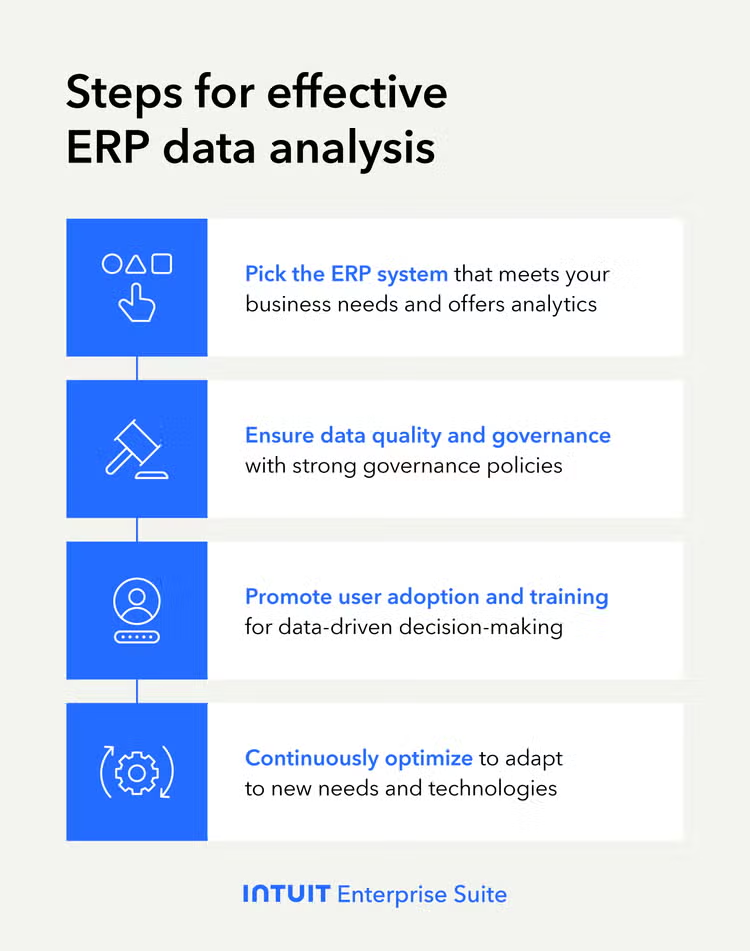
Choosing the right ERP system
Look for a system that aligns with your business needs and offers robust ERP analytics capabilities. Consider scalability, ease of integration with existing tools, and the ability to customize reports and dashboards to suit your specific requirements.
The stakes of getting this decision wrong are significant. Gartner predicts that by 2027, more than 70% of recently implemented ERP initiatives will fail to fully achieve their original business goals, often because organizations selected a platform without adequately mapping it to their operational requirements. For multi-entity companies, that means confirming native support for consolidated reporting, intercompany accounting, and entity-level permissioning before committing to a platform.
Data quality and governance
High-quality data is the foundation of accurate ERP analysis. Establish clear data governance policies to ensure data is accurate, complete, and up-to-date. Also, implement processes for regular data cleaning and validation to prevent errors and maintain data integrity, which is essential for reliable analysis and reporting.
The cost of skipping this step is measurable. According to Gartner, poor data quality costs organizations an average of $12.9 million annually across all industries, driven by downstream decision errors, compliance exposure, and operational rework. For multi-entity finance teams, those costs compound when inconsistent master data or chart of accounts mapping creates errors that only surface at period-end consolidation.
User adoption and training
Successful ERP implementation relies on user adoption and proper training. Ensure employees understand how to effectively use the necessary accounting software, like an ERP system, and know the benefits of data-driven decision-making. Don’t forget to provide ongoing training and support to help users leverage the system's full potential and integrate it into their daily workflows.
The people side of implementation consistently outweighs the technical side in determining outcomes. According to Prosci's 2025 Unlocking ERP Implementations study, human factors matter six times more than technical factors in improving ERP benefits. Finance teams that receive structured, role-specific training on close workflows, consolidated reporting, and AI-generated insights extract significantly more value from the platform over time.
Continuous improvement and optimization
ERP data analysis is not a one-time setup but an ongoing process. Regularly review and refine your data analysis practices to adapt to changing business needs and emerging technologies. Don't overlook the importance of regularly evaluating system performance and seeking user feedback. Make adjustments based on your analysis to improve the effectiveness of your ERP analytics and overall data strategy.
Organizations that treat their ERP as a static implementation tend to fall behind those that actively optimize it. According to our Enterprise Technology Benchmark Report, 92% of senior business and finance leaders are redesigning core processes around AI right now, treating their systems as something to continuously adapt rather than something to set and forget. For finance teams, that means building a regular review cycle to assess whether reports, dashboards, and workflows still reflect how the business actually operates.
Best practices for ERP data analysis
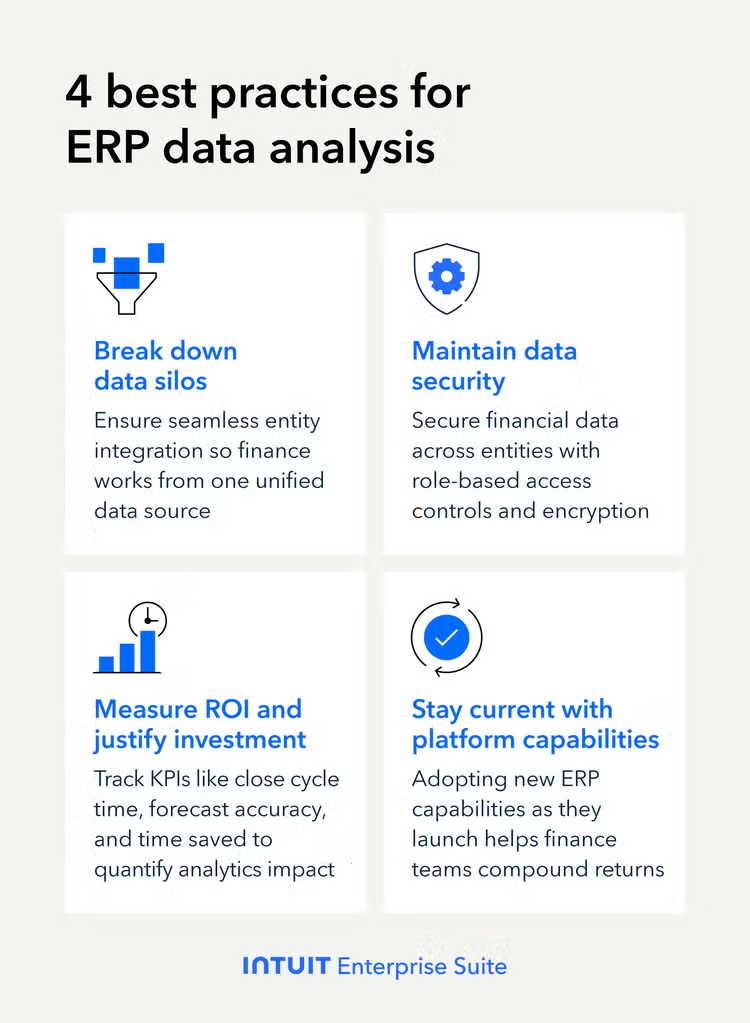
Successful ERP data analysis requires adherence to these best practices:
- Overcoming data silos and integration challenges: Break down data silos by ensuring seamless integration across systems to provide a unified view of your data for comprehensive analysis.
- Ensuring data privacy and security: Implement strong security measures, including encryption and access controls, to protect ERP data and regularly update protocols to address new threats.
- Measuring ROI and justifying investment: Track key performance indicators (KPIs) to calculate the ROI of your ERP analytics. You can use this data to justify investments and guide future decisions.
- Staying updated with emerging trends: Keep abreast of the latest trends and technologies in ERP analytics to continuously improve your practices and leverage innovations for a competitive edge.
Turn faster closes into faster decisions
For multi-entity finance teams, the gap between closing the books and understanding the business often comes down to data infrastructure. When your ERP data analysis runs on a unified, real-time platform, that gap closes. You spend less time assembling reports and more time acting on them.
That shift, from closing the books to understanding the business, is what unified data infrastructure makes possible. Finance teams stop spending their time assembling reports and start spending it acting on what those reports show. Intuit Enterprise Suite delivers that shift in practice, giving CFOs and Controllers consolidated visibility, AI-powered automation, and unified financial and operational reporting across every entity.