How finance teams use data-driven decision-making to optimize actions

Key takeaways:
- Data-driven decision-making requires verified, current, and contextualized data. Without all three, even a sophisticated system can produce a signal that misleads finance.
- Validation lag is the time between identifying a signal and confirming its cause, and it forces finance teams to choose between speed and accuracy.
- Gartner research found that 18% of accountants make financial errors every day. Most of those errors originate in the manual verification workflows finance teams use when they can't trace system signals back to their source.
- Accountants report error rates of 59% per month in environments reliant on manual verification. Data-driven decision-making only holds up when the signal, the source transaction, and the business context are visible in the same place.
The controller at Western Companies couldn't finalize audited financials for months. Lenders needed quarterly financials to issue lines of credit. The data existed. It just couldn't be verified fast enough to act on.
After implementing the Intuit Enterprise Suite ERP platform, Western Companies achieved a 90% faster audited financial review time, and the CFO can now deliver a P&L or balance sheet to lenders within minutes. That visibility supported $9 million in growth in a single year.
Your systems surface more anomalies than ever. AI flags a revenue dip in one entity. A consolidated dashboard shows DSO climbing across two subsidiaries. An automated workflow fires on an intercompany imbalance. Each alert arrives in seconds, but the investigation that follows can take days.
For multi-entity firms managing $10M+ in revenue across subsidiaries with different close schedules, approval hierarchies, and accounting conventions, that lag has direct consequences for cash flow, forecast accuracy, and board credibility. This post covers how finance teams build the validation layer that closes it.
What is data-driven decision-making in enterprise finance?
Data-driven decision-making is the practice of grounding every significant financial or operational action in verified, current, and fully contextualized data, rather than in estimates, lagged reports, or aggregated signals that haven't been traced to their source.
For enterprise finance leaders, that definition has three operating requirements. The data must be:
- Verified: Confirmed against its originating transaction, not just reported in a dashboard.
- Current: It reflects the state of the business at the time of the decision, not last week's export.
- Contextualized: It is readable in the full operational context of the entity, project, or cost group it belongs to.
Remove any one of these three, and the decision built on that data is subject to error, regardless of how sophisticated the system that generated the signal.
At a multi-entity firm, each requirement carries additional weight. Verified data must be traceable across entity boundaries, not just within a single ledger. Current data must be aggregated in real time from subsidiaries that may close on different schedules. Contextualized data must be readable at both the group level and the entity level. That operational standard is the baseline for decision-ready finance.
How finance teams turn business insights into validated decisions
Modern financial systems excel at surfacing anomalies. They flag margin compression, cash flow shortfalls, intercompany imbalances, and AR aging exceptions faster than any manual review process could. But surfacing a signal and providing the context required to act on it are two different capabilities, and most platforms stop at the first one.
For a $10M+ enterprise, seeing a red flag is only the beginning. The real work is confirming the why before committing capital or changing course. A system-generated trend becomes decision-ready only when it is backed by verifiable operational data, like the:
- Specific entity
- Account
- Approval chain
- Reporting period
That isn't a technical step. It is a core finance responsibility that bridges the gap between raw reporting and strategic execution. The goal is what practitioners increasingly call validation velocity.
What validation velocity means in practice
Most multi-entity finance teams feel this problem daily, even without a name for it. We call it validation velocity, which is the speed at which a finance team can move from a flagged signal to a documented, defensible decision without manual investigation across disconnected systems.
It is measured not in dashboard refresh rates, but in how quickly a Controller can confirm whether a consolidated variance is a process issue in one entity or a structural risk across the portfolio.
The firms with the shortest validation cycles are the ones where financial and operational data live in the same environment, and where drill-down traceability is built into the reporting layer, not bolted on.
Why standard data signals are not inherently decision-ready
A system-generated trend is often a lagging indicator. By the time a margin dip appears in a consolidated dashboard, the underlying cause, whether a specific supplier price increase, a project cost overrun, or a billing delay in one subsidiary, may have been building for weeks.
The signal tells you something has changed. It doesn't tell you what drove the change, which entity owns it, or whether it represents a temporary variance or a structural shift.
PULSEROLLER, a multi-entity manufacturer supplying Amazon, Walmart, and the US Postal Service, experienced this directly. Without dimensional reporting across its three business units, R&D spending consistently obscured the true profits of its primary business.
As Brandon Webster, Director of Finance, put it: *"We needed the ability to create financials at the parent level to show the organization as a whole, without having to do off-the-napkin calculations using Excel."*
The data was there. The context that made it actionable wasn't.

Fragmentation compounds this problem at scale
When subsidiaries operate on different systems or use inconsistent account coding, a CFO looking at a consolidated report cannot immediately distinguish between a timing difference in one ledger and a recurring cost pressure across the organization.
Lango, a language services firm that scaled through seven acquisitions, found its accounting team losing 25 to 30% of their weekly capacity while reconciling seven different spreadsheets. With data siloed across instances, 22% of their receivables were over 90 days late, not because collections were failing, but because the visibility required to manage them didn't exist.
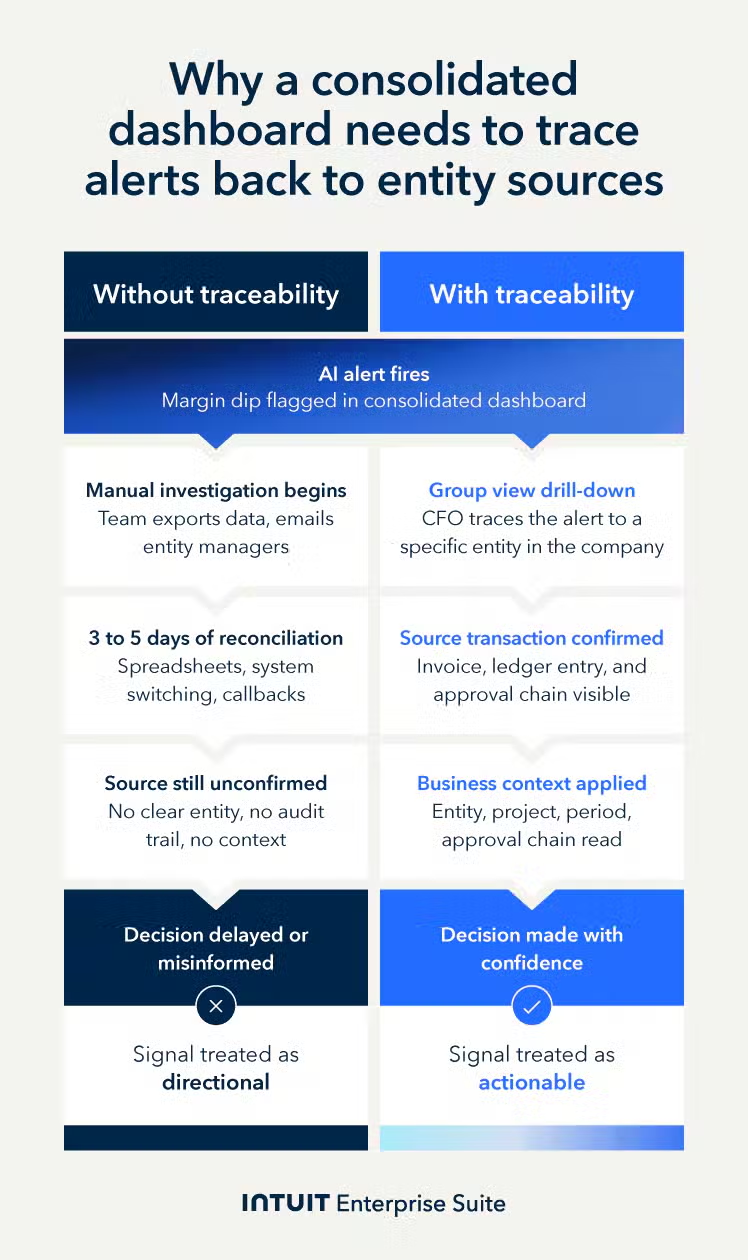
When a CFO cannot immediately see the drivers behind a signal, the default response is predictable: manual verification, calls to entity managers, or decisions made on incomplete information. That response negates the speed that automated reporting was supposed to provide.
A Gartner report found that 18% of accountants make financial errors every day, and 59% make several errors per month. Spreadsheet-driven verification workflows are where those errors concentrate.
A consolidated report doesn't carry the operational story needed to justify a strategic pivot. The three to five days finance teams spend calling entity managers or reconstructing data in spreadsheets, instead of acting on verified information, is the direct cost of treating signals as decisions rather than as starting points for validation.
The cost of the validation lag: Speed vs. accuracy
When the validation process is slow, finance teams face a choice that shouldn't exist: act quickly on unvalidated data and risk a misstep, or act slowly and miss a market window. Neither outcome reflects a high-functioning finance function. Both trace to the same structural problem, the gap between when a signal fires and when the context required to act on it becomes available.
Leadership identifies a significant opportunity or threat (like a competitor exiting a market, a supply chain disruption, a cash position that could support an acquisition), but the finance team cannot pull the trigger because the underlying data hasn't cleared verification. The board meeting happens before the investigation closes. The decision gets made on incomplete information, or it doesn't get made at all.
Western Companies lived this problem before implementing Intuit Enterprise Suite. The company's controller couldn't finalize audited financials for months, which directly threatened their access to lender credit lines. The firm was saving $1,800 per month on third-party consolidation tools that still couldn't produce reliable, timely numbers.
The downstream cost wasn't just the tool spend. It was the executive decisions that couldn't be made, and the capital windows that closed while verification was still in progress.
The downstream effects of unreliable validation are specific:
- Analysis paralysis on time-sensitive decisions
- Higher effective cost of capital when delayed action increases borrowing costs or reduces negotiating leverage
- Reactive posture that positions finance as a reporting function rather than a strategic partner.
Research published in the Journal of Capital Markets Studies found that audit reporting lag is directly associated with a higher cost of equity capital. This finding extends to any strategic decision-making environment where verified data arrives late.
The firms that consistently outperform on decision quality are the ones where validation is built into the reporting layer, not performed after the fact.
How to build a decision-ready validation framework
A decision-ready validation framework restructures the environment so that the data required to act arrives already verified. The four components below address each layer of the gap: data unification, native traceability, real-time visibility, and integrated execution.

1. Unify operational and financial data for immediate context
A decision-ready framework requires financial and operational data to exist in a shared environment. When they're separated, financials in one system, project data in another, payroll in a third, the CFO can see the number but not the story behind it. Unification closes that gap.
In a unified environment, the CFO can see the why behind a signal without leaving the system. A margin compression alert surfaces alongside the specific SKU shortage or billable hour gap that drove it. A cash flow variance appears with the project billing schedule that explains the timing. Context is native to the signal. That immediacy is what turns a report into a decision, rather than the starting point for another round of investigation.
Lango's experience illustrates what's at stake. After consolidating seven acquired entities onto a single platform, their month-end close dropped from 45 days to 15, a 66% acceleration. More directly, 90-day-plus outstanding receivable balances dropped from 22% to less than 2%, immediately easing the strain on cash flow.
The accounting team, previously consuming 25 to 30% of weekly capacity on manual reconciliation, pivoted to core strategic analysis. As Josh Daneshforooz, CEO and Founder, put it: "Without unified data, you can't manage cash, you can't manage growth, and you definitely can't manage trust."
2. Establish native traceability to the source transaction
The ability to drill down from a consolidated report directly into the subsidiary-level invoice or ledger entry provides an immediate audit trail and eliminates the primary source of validation lag. Native traceability replaces hours of manual investigation with minutes of directed review.
This is an operational standard, not a feature preference. If a Controller has to export data, switch systems, or request records from an entity manager to confirm the source of a variance, the validation process is disconnected from the reporting layer. That disconnection is where errors accumulate and where verification cycles stretch from hours into days.
Rhodes Companies, a nine-entity family-owned company, saw this directly when AI-driven insights detected a 50% variance in a prepaid asset that manual processes had not caught.
The same platform that flagged the anomaly provided the drill-down path to confirm it, cutting month-end close from 10 days to 5 and reducing consolidated report turnaround to 5 minutes. As CFO Caleb McDaniels noted: "We've cut our [reporting] time at least in half of what we were spending before."
The table below shows what native traceability changes in practice:
3. Implement real-time visibility across all entities and teams
A single, consolidated view of all entity data updated in real time ensures that validation isn't delayed by manual data requests or lagged subsidiary reports. It also provides the group-level perspective required to distinguish a localized event from a systemic trend.
When a margin alert fires, the question a CFO needs answered immediately is, "Is this one entity or three?" "A timing difference or a structural shift?" "A variance that's been building for 90 days or one that appeared this week?"
Those questions require instant cross-entity visibility, not a report that aggregates last week's closes from five different systems.
Western Companies' controller now receives accurate numbers monthly rather than waiting weeks for a historical snapshot. That real-time visibility supported $9 million in growth in a single year and changed the firm's relationship with its lenders.
Brady Martin, CFO, described the outcome clearly: "Having audited financial reviews back in a month is unheard of. Our auditor of four years is more confident in us because our financials are accurate without the constant adjusting entries."
4. Shorten validation cycles by integrating analysis and action
Validation is most effective when reporting, analysis, and execution happen in the same environment. When a CFO confirms the source of a variance in one system and then has to initiate a response in another, the handoff creates both delay and documentation risk.
Integration allows for continuous validation: signals are verified as they occur rather than during a frantic month-end close. An intercompany imbalance that surfaces mid-period and is resolved in the same platform, through an automated workflow that matches the entry, routes it for approval, and logs the resolution, never becomes a close-week escalation.
Lallier Construction, a four-entity Colorado construction firm, reduced intercompany reconciliation time by 90% after implementing Intuit Enterprise Suite. The team shifted from 10 to 20 hours per week on data entry to two to four hours per week on data analysis, an 80 to 90% efficiency gain. That time didn't disappear. It moved from reconstruction to decision-making strategies.
Driving strategic business decisions through data-driven insights
The CFOs who operate as genuine strategic partners share a common capability: they can move from a signal to a verified, contextualized decision without the days-long lag that forces a choice between speed and accuracy. That capability isn't a function of analytical skill. It is a function of the environment in which those decisions are made.
Intuit Enterprise Suite provides multi-entity finance teams with the unified data, native traceability, real-time visibility, and integrated execution layer that decision-ready finance requires. With a 299% ROI modeled in the Forrester TEI study, the platform delivers both the speed and the accuracy that strategic financial decision-making demands, without asking finance to choose between them.
Schedule a demo to see how Intuit Enterprise Suite gives your team the validation layer it needs to act with confidence on every signal, at every entity, in every period.