Financial reporting: Types, standards, and best practices

Key takeaways
- Accurate financial reporting is critical for business stability, as it provides data-driven insight into cash flow and profitability.
- Balance sheet, income statement, cash flow statement, and statement of changes in equity or retained earnings are essential for understanding financial position and performance.
- Following applicable accounting standards, such as US GAAP or IFRS Accounting Standards, supports consistent, transparent financial reporting and audit readiness.
When Lango automated multi-entity consolidation in Intuit Enterprise Suite, its month-end close dropped from 45 days to 15. That 66% reduction cut 30 days from the reporting cycle.
For CFOs and controllers running multiple entities, that speed is the point. Accurate statements are table stakes. The real question is whether you can get a reliable, consolidated view of the business while the numbers still matter for the decision in front of you.
This guide covers how financial reporting works and, more to the point, how finance leaders use it to manage performance, forecast with confidence, and keep every entity visible as the organization grows.
https://main--erp--intuit.aem.page/fragments/media-promo/c21d6r8ia
What is financial reporting?
Financial reporting is the process of organizing and presenting a company's financial data to show its position and performance over time. It draws on revenue, expenses, cash flow, assets, liabilities, and profitability to give internal stakeholders, investors, lenders, and regulators a consistent view of the business.
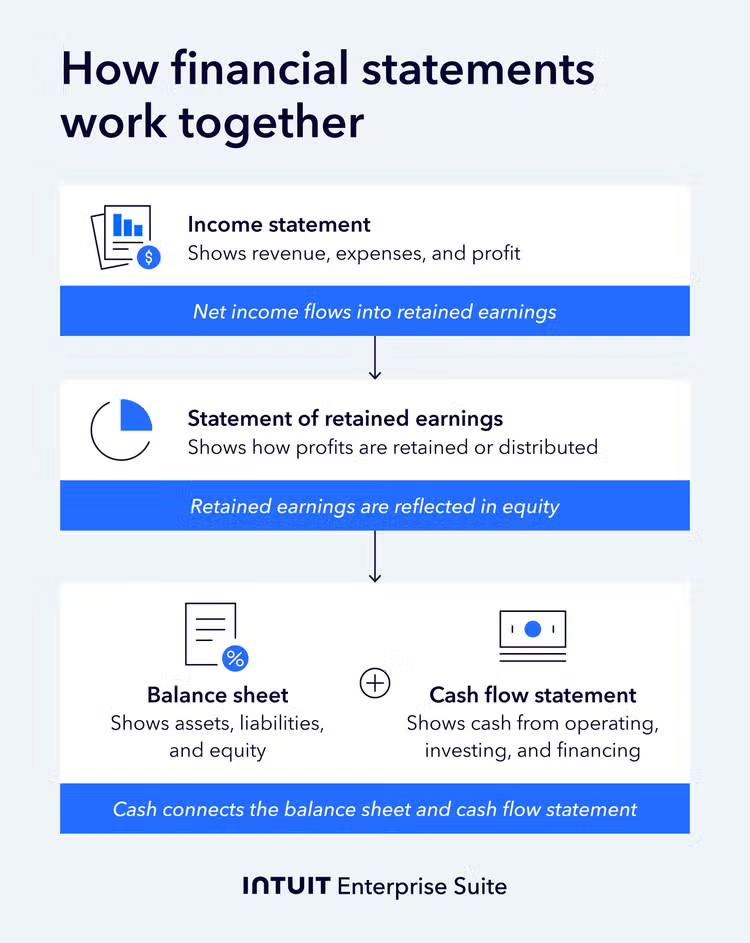
Four core statements do most of the work:
Together, they show what a company owns and owes, how it earns and spends, and how cash moves through the business. Accounting produces the underlying data; financial reporting turns it into structured information for analysis and compliance.
How do finance leaders actually use financial reporting?
Reporting matters because of what it lets you do. Finance leaders use it to monitor performance, spot trends early, evaluate profitability by entity or product, manage cash flow, and provide executives with the evidence they need to make decisions.
The faster that loop runs, the more useful it is. At Sparq Partners, a fractional CFO firm supporting $122 million in client revenue across 15 entities, fluctuation and revenue analysis that once took two full days now surfaces in minutes.

Reporting also surfaces problems worth acting on. When Lango tracked billable utilization and cost of goods sold at the entity level, it found one regional unit operating with thin gross margins due to high contractor costs. That visibility led to a staffing change that improved profitability, a decision that only shows up when reporting reaches the entity level.
Executive and board reporting, KPI monitoring, and forecasting extend the same idea: reporting is the mechanism that turns financial data into management action.
Internal vs. external financial reporting
Financial reporting serves different audiences. Internal reports are tailored to how you run the business; external reports emphasize consistency and compliance with reporting standards.
- Internal financial reporting: CFOs and FP&A teams use it to track performance, build forecasts, and manage risk. Tailor these reports around the dimensions that matter most—entity, location, product, or department.
- External financial reporting: Investors, lenders, and regulators use it to assess performance, position, and risk, so external reports follow prescribed accounting standards and disclosure requirements.
You'll run both at once. In a multi-entity business, the hard part is making them reconcile, so the consolidated numbers you take to the board tie cleanly to the entity-level detail your controllers work from.
What financial reporting standards apply?
Standards exist so stakeholders can compare financial results consistently. US domestic public companies report under US GAAP, while IFRS Accounting Standards are required or permitted in many jurisdictions outside the United States. The applicable framework depends on where an organization operates and its reporting obligations.
US domestic public companies are also subject to SEC disclosure requirements, including annual Form 10-K and quarterly Form 10-Q filings. Most privately held companies are not subject to those periodic SEC filing requirements, but they may still prepare financial reports for lenders, investors, tax reporting, and internal governance.
Where does financial reporting break down as you add entities?
Reporting rarely fails on a single entity. It fails at consolidation.
Every acquisition or new entity can introduce another data source, another chart of accounts, and another set of intercompany transactions to eliminate. Lango grew through seven acquisitions, each on its own QuickBooks instance, which Lango's CEO called "a labyrinth of logins and a maze of manual mapping" in Excel.
The accounting team lost 25–30% of its weekly capacity reconciling seven spreadsheets, and the close stretched to 45 days.
Aprio, a Top 20 CPA-led advisory firm with 3,200+ accountants, saw the same pattern across its mid-market clients: businesses managing 10 to 15 QuickBooks Online or Desktop instances alongside Excel-based consolidations. The manual consolidation work made it harder to streamline the monthly close and left less time for higher-value advisory work. With Intuit Enterprise Suite, Aprio had a path to support clients as they moved into greater multi-entity complexity.
When consolidation is manual, the numbers arrive late, and confidence erodes. This is the point where a connected ERP can earn its place.
What makes a good financial reporting cadence?
A good financial reporting cadence matches the frequency of each report to the decisions it supports. Not every metric needs daily attention, and reporting more often doesn't necessarily make the information more useful.
The goal is to balance speed with reliability. Reports that arrive quickly but contain incomplete data can undermine confidence, while fully reconciled information that arrives too late may limit a leader's ability to respond. Assigning clear owners, deadlines, and review steps helps finance teams maintain a predictable cadence rather than responding to reporting requests on an ad hoc basis.
A connected platform can help finance teams maintain that predictability as complexity grows. Before Intuit Enterprise Suite, the manual effort required to close the books and complete Sparq Partners’ quarterly re-forecasts within 45 days left little room for higher-level analysis. Today, fluctuation and revenue analysis that once took up to two full days can be completed in minutes.
Financial reporting best practices
Effective financial reporting depends on consistent data, repeatable processes, and reports designed around the information stakeholders actually need. Finance teams can improve reporting quality and efficiency with these best practices:
- Standardize financial data and definitions: Use consistent account structures, reporting dimensions, and KPI definitions so results can be compared reliably across periods, entities, and teams.
- Reduce manual reporting work: Automate repetitive data collection, consolidation, and report preparation where possible, while maintaining appropriate finance review and controls.
- Build reports around decisions: Start with the question a stakeholder needs to answer rather than filling reports with every available metric.
- Maintain a consistent review cadence: Establish reporting owners, deadlines, and review steps so stakeholders know when information will be available and so finance isn't rebuilding the process each period.
- Provide appropriate access: Give stakeholders access to the financial information relevant to their roles while maintaining permissions and controls around sensitive data.
Before adding another report or dashboard, identify the decision it should support, who owns it, and how frequently the underlying information needs to change. If those answers aren't clear, the report may be adding volume rather than visibility.
https://main--erp--intuit.aem.page/fragments/media-promo/c1oq2tnlh
Turn reliable financial reporting into clearer business decisions
Strong financial reporting depends on consistent data and repeatable processes that give leaders a timely, consolidated view. As entities multiply, automation is what keeps that view current.
Intuit Enterprise Suite is the AI-native ERP and connected platform that brings financial data, multidimensional reporting, and analysis into one place. Automated multi-entity consolidation and intercompany operations help shorten the close while giving finance teams real-time visibility across entities.
Recommended for you
Turn reliable financial reporting into clearer business decisions
Strong financial reporting depends on consistent data and repeatable processes that give leaders a timely, consolidated view. As entities multiply, automation is what keeps that view current.