Learning management system: Diffrent types of LMS & their benefits

As a business leader, you are always looking for ways to streamline operations, increase efficiency, and support team growth. In the 2024 Intuit QuickBooks Business Solutions Survey, 95% of respondents reported that digital business solutions help them to scale.
Learning management system (LMS) technology offers an efficient way to help teams address skill gaps, improve compliance, and boost employee engagement. In this post, we’ll explore how an LMS system supports the scalability and agility of your growing mid-sized company.
What is a learning management system?
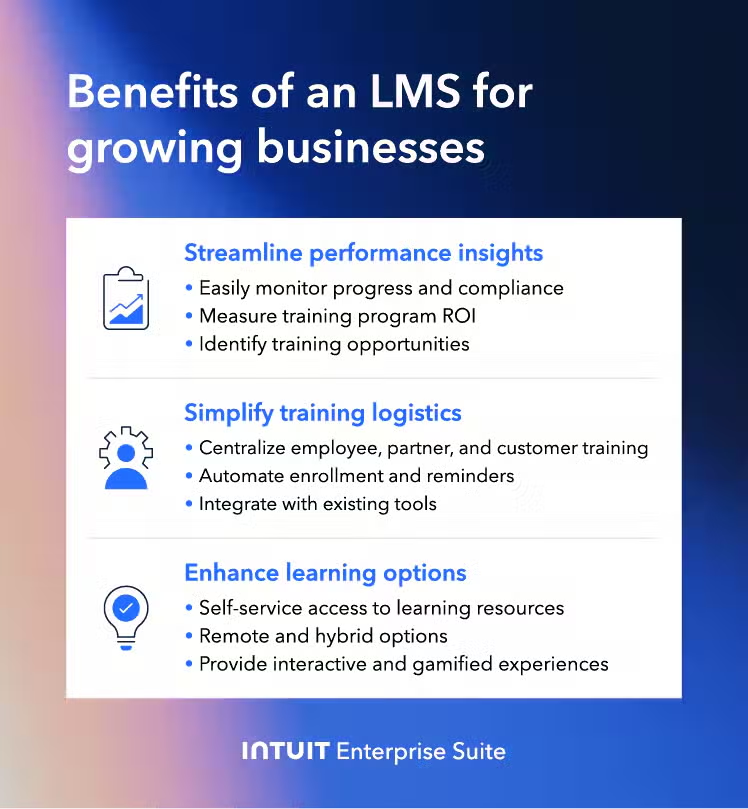
An LMS platform is designed to centralize employee training and development within an organization. It helps companies create, deliver, track, and manage various employee learning programs. At its core, an LMS:
- Simplifies training logistics
- Reduces administrative tasks
- Ensures a consistent learning process across all departments
For example, a retail company with 500 employees might use an LMS to roll out new product training simultaneously across all locations, reducing the need for managers to manually track progress, and freeing up time for customer-facing tasks.
Viewed as a strategic investment, an LMS goes beyond training—it’s about fostering continuous learning to align with business goals. For your mid-sized business experiencing growth, an LMS ensures that training scales with complexity, helping maintain an agile, skilled workforce.
Whether onboarding new hires or upskilling current employees, an LMS ensures that the right individuals gain the right skills at the right time, aligning talent with organizational needs.
Strategic benefits of an LMS
Investing in an LMS offers both immediate and long-term advantages for your organization. Here’s how:
1: Optimized ROI
An LMS allows you to track the effectiveness of your training programs, ensuring they deliver measurable results and maximizing your investment in learning development.
2: Scalable growth
As your business expands, an LMS integrates with existing tools and scales with you, accommodating new employees and training content without adding complexity to your processes.
3: Enhanced employee engagement
Ongoing training opportunities through an LMS can improve employee performance and satisfaction, reducing turnover and helping you retain top talent.
4: Reduced administrative tasks
An LMS reduces administrative overhead by automating tasks like progress tracking and reporting, allowing your team to focus on higher-value activities.
5: Improved learning consistency
An LMS standardizes training across the organization, delivering consistent learning experiences regardless of location or department.
LMS deployment options and features
Selecting the right LMS depends largely on your company’s needs and resources. Here are a few deployment options to consider, each offering unique advantages.
Cloud-based LMS
A cloud-based LMS system provides flexibility and scalability, as it’s accessible from anywhere with an internet connection. This option is ideal for businesses that prioritize remote work or global teams. Plus, it requires less upfront investment in hardware, making it a cost-effective choice for growing businesses.
Self-hosted LMS
Instead of hosting on the cloud, a self-hosted learning system integrates with existing systems and provides more security, protecting against data security threats. For companies that value more control over data and customization, a self-hosted LMS might be the best fit.
Open-source LMS
Open-source LMS platforms, like Moodle and Open edX, offer customization and cost savings, with free, modifiable code. Ideal for companies with IT expertise, they provide flexibility and independence but require technical resources for setup and maintenance.
Mobile and Hybrid LMS
In an increasingly mobile world, an LMS that supports mobile learning is essential for reaching employees who are on the go. A hybrid model, which combines cloud-based access with mobile compatibility, is ideal for businesses seeking to offer flexible, anytime, anywhere learning.

LMS applications across business functions
An LMS isn’t just for internal employee training—it has versatile applications across several business functions, each contributing to overall business expansion. Here are some learning management system examples and their applications:
- Employee training and development: LMS can host programs for onboarding, skill-building, leadership development, and more.
- Compliance and regulatory training: Ensure that employees are always up to date with the latest industry regulations and compliance standards.
- Customer education: Use your LMS to offer education programs to customers, helping them better understand products and services.
- Sales and partner training: Streamline training for your sales teams and business partners, ensuring they have the latest information to drive sales, manage orders, and support your business.

Picking an LMS for your growing, complex business
Choosing the right LMS for your organization requires balancing features, costs, and long-term value. Whether you’re prioritizing ease of deployment or customization, here are key factors to consider:
- Type of LMS: Subscription-based LMS platforms offer a quick setup, lower upfront costs, and ongoing vendor support, making them ideal for businesses seeking simplicity. Open-source LMS options provide flexibility and customization but require technical expertise and dedicated IT resources for maintenance.
- Total cost of ownership (TCO): Beyond the purchase price, factor in hidden costs like maintenance, updates, and potential expansions. A low upfront cost may lead to higher expenses over time, so evaluate the full financial impact before committing.
- Scalability and flexibility: As your business grows, your LMS should grow with it. Look for a platform that supports adding users, new features, and integrations without significant downtime or extra costs.
- User experience: An intuitive interface and mobile accessibility ensure higher adoption rates, making it easier for employees to engage with the system and complete training.
While considering which LMS is right for your business, consider how all your tools and processes integrate. The Intuit Enterprise Suite makes managing all the tools for your growing business easier.
How to implement an LMS for your business
Successfully implementing an LMS requires thoughtful planning, stakeholder collaboration, and strategic testing. Follow these steps to ensure a smooth deployment:
- Assess business needs: Identify your organization’s goals, training needs, and potential challenges. This foundation will guide your LMS selection and implementation plan.
- Run a pilot program: Test the LMS on a small scale to evaluate its performance, user-friendliness, and compatibility with existing systems. Use feedback to refine processes before full deployment.
- Engage stakeholders: Involve HR, IT, and end-users early in the process to gather input, build consensus, and ensure the system meets diverse needs.
- Provide training and support: Train employees on how to use the LMS effectively and offer ongoing support to address questions or technical issues. This maximizes adoption and ensures long-term success.

Boost productivity and enhance profitability
To select the right LMS for your organization, consider overall cost efficiency, scalability, and long-term impact. With a strategic approach to adopting LMS technology, your company can enhance employee development, streamline compliance, and achieve a stronger return on investment, ultimately driving better business performance.
As your business grows, improve productivity and decision-making with an all-in-one solution for business and financial management.
Learning management system FAQ
Organizations typically achieve ROI from an LMS within 6 to 18 months, depending on adoption rates and training efficiency improvements.
For example, Global Retail Inc. invested $250,000 in an LMS and, within six months, increased employee productivity by 30%, adding $1.5 million in revenue. Similarly, HealthFirst, a healthcare provider, achieved a 4x ROI in 18 months by reducing complicated-related fines by 20%.