ERP for construction: How to protect margins from bid to closeout

Key takeaways:
- Construction CFOs managing multiple entities lose margin visibility when job cost data lives outside their financial system.
- Real-time WIP reporting and AI-powered insights let finance teams catch budget drift across projects and phases before it becomes a write-down.
- AIA-style progress billing, integrated change orders, and connected A/R workflows close the gap between work completed and cash in hand.
- Automated intercompany eliminations and consolidated reporting under a single login cut close time and reduce audit risk across every entity.
According to KPMG's Global Construction Survey, 37% of firms missed budget or schedule targets in the past year due to ineffective risk management. For CFOs and Controllers managing multiple entities, that figure has a direct line to the income statement. It usually shows up too late to act on.
Most construction finance teams are running the same setup: job costs in one system, billing in another, consolidation happening in spreadsheets at period-end. The question is not whether the gap exists. It's how long you're waiting to see it.
This guide covers how ERP for construction companies uses purpose-built financial platforms to avoid overruns, close deals faster, and maintain visibility across every entity in their portfolio. For a broader context on strategic cost management at the enterprise level, that post is a useful starting point.
Catch cost overruns before they erase margin
A McKinsey analysis of more than 500 capital projects found that cost overruns averaged at least 79% above initial budget estimates. For finance teams managing multiple projects across entities, that number is the baseline they're managing against.
For most construction finance teams, budget-vs-actuals visibility arrives at month-end, well after any corrective action is possible. The root cause is data lag. Estimates live in one place, actual costs accumulate in another, and the reconciliation between them happens manually, at close.
On a single project, that's manageable. Across a portfolio spanning multiple entities, it becomes a systematic margin leak.
For construction businesses running multiple entities, the problems tend to cluster in the same places. Here is where generic accounting tools fall short and what a purpose-built platform delivers instead.
Why overruns arrive too late
For most construction finance teams, budget-vs-actuals visibility arrives at month-end, well after any corrective action is possible. The root cause is data lag.
Estimates live in one place, actual costs accumulate in another, and the reconciliation between them happens manually, at close. On a single project, that's manageable.
Across a portfolio spanning multiple entities, it becomes a systematic margin leak. Most construction software solutions on the market track activity. They don't connect it to financial outcomes in real time.
Real-time visibility across cost groups and phases
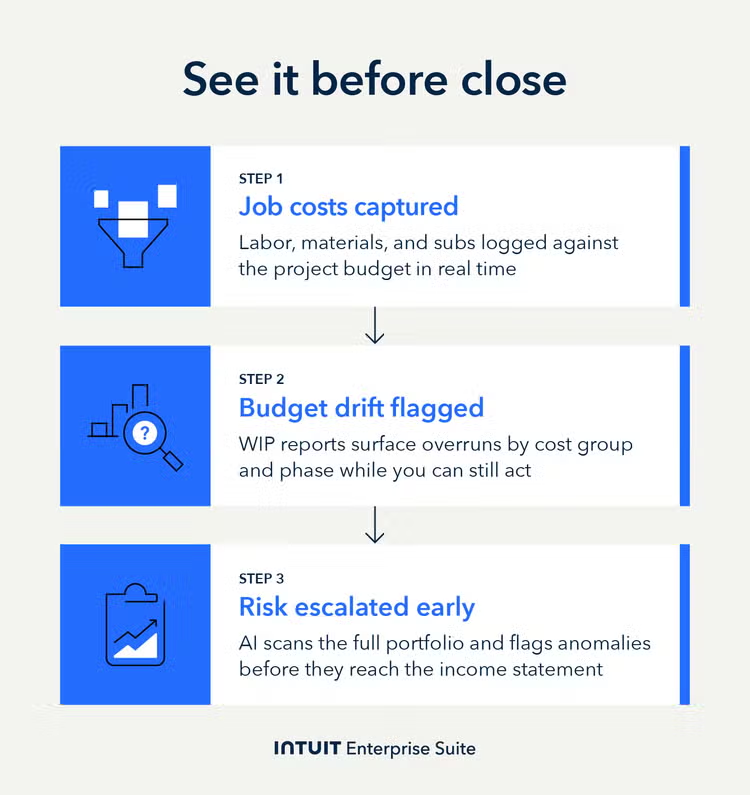
Intuit Enterprise Suite closes that lag at the job level. Historical job cost data from completed projects feeds directly into the estimating process, so pre-bid numbers reflect what work actually costs.
Once a project is underway, real-time WIP reports surface budget drift across cost groups and phases while there is still time to act. Redirect resources, adjust scope, or escalate before a single job damages a quarterly result.
AI-powered insights scan the full project portfolio and flag risk patterns before they compound. Cost allocation recommendations reduce the manual work of distributing shared expenses across entities, and proactive alerts surface anomalies that would otherwise stay buried until close.
The multi-entity dimension
Budget-vs-actuals visibility across every job in every entity, available in real time rather than assembled at period-end, is what separates a finance team that manages margin from one that reports on it after the fact.
Tracking gross margin by job and entity is only useful when the data behind it is current. Here’s a closer look at how project cost estimation feeds into that margin picture from the pre-bid stage.
The proactive [AI-powered] insights in Intuit Enterprise Suite ensure that we're not missing anything during our month-end process.
Caleb McDaniels, CFO at Rhodes Companies
Stop being profitable on paper and cash-starved in reality
Contractors frequently close months with strong gross margins on the income statement and empty bank accounts. The gap between work completed and cash collected is a structural problem in construction finance, and it widens as the entity count grows.
The billing friction problem
When draw requests are assembled manually, disconnected from actual costs and milestone completion, they take longer to prepare, invite more lender scrutiny, and create disputes that delay payment.
Each day of delay has a direct cost to working capital. This is one of the most common pressure points finance leaders cite when evaluating ERP software for construction. The gap between field activity and the financial system is where cash flow problems start.
Intuit Enterprise Suite ties every draw request to phases, costs, and milestones in a format that GCs and lenders typically accept. Progress billing follows AIA-style standards. Scope changes move through integrated approval workflows before touching the financials, including deductive change orders, so nothing slips through or gets disputed after the fact.
Closing the gap between invoicing and collection
Connected A/R workflows close the last gap. When invoicing is triggered the moment work is done rather than days later, the billing cycle compresses and DSO comes down. This creates the sequence of billing accuracy, billing speed, and payment collection, which drives cash flow predictability.
Jason Corby, Founder and CFO at HFMM Legacy Group, on managing a complex, multi-entity construction business through one platform:
"In construction and landscaping, there's a ton of activities, a ton of employees. Intuit Enterprise Suite allows us to capture all of the activities and people in a very complex business. It allows us to manage them all in one place."

Consolidate and close across every entity
Manual consolidation is the hidden cost of multi-entity construction finance. When each subsidiary maintains its own books, intercompany transactions require manual settlement, eliminations have to be tracked in spreadsheets, and the close process becomes a coordination exercise across teams working from different data sets.
What the time cost actually looks like
A Forrester TEI study commissioned by Intuit modeled 75–95% time savings on annual data entry tasks for Intuit Enterprise Suite users, representing 390–494 hours per year. That reduction directly compresses close cycles and reduces the manual risk that creates audit exposure.
One login, every entity
Intuit Enterprise Suite manages all entities, locations, and subsidiaries under a single login. Intercompany eliminations are automated, so consolidation that previously required a spreadsheet sprint at period-end becomes a platform function. Management reports, custom metrics, and peer benchmarking are available natively.
Up to 20 customizable dimensions let finance teams slice consolidated reporting by entity, project, region, phase, or any combination that reflects how the business operates. Role-based access controls ensure each level of the organization sees what it needs without overexposing financial detail.
Built-in audit trail
The audit trail is built into the process. Preparer, approver, and supporting evidence are captured as work happens across every entity. Tracking the right financial KPIs at the entity and portfolio level is what makes that audit trail actionable rather than just archival.
The Forrester TEI study projected a 299% ROI over three years for Intuit Enterprise Suite customers, reflecting efficiency gains across close, reconciliation, and intercompany management.

Replace stitched-together point solutions with one platform
Most growing construction firms don't arrive at tool sprawl intentionally. They add a billing solution here, a project management tool there, and eventually find themselves running a stack where estimates, budgets, and invoices live in three different systems that don't communicate reliably.
The cost of disconnected systems
Every data hand-off between systems is an opportunity for an error or a delay. Finance teams reconciling data across disconnected tools spend hours each period on work that produces no analytical value. This is the core limitation of generic ERP for the construction industry: systems that weren't built around how construction revenue is earned, billed, and collected.
Intuit Enterprise Suite found that 83% of the time previously spent on technology vendor management can be recovered by consolidating onto a unified platform.
One connected workflow from bid to closeout
On Intuit Enterprise Suite, estimates, budgets, and invoices flow together without re-entering data. When a change order is approved, it moves directly into the financial system. When work is completed, billing is triggered from the same data set as the project budget. There are no handoffs—it's one connected workflow from bid to closeout.
Rules-based automation handles cost allocation, recurring intercompany transactions, and routine approval routing, removing the manual steps that slow down month-end and introduce inconsistency across entities.
Understanding EBIT as a profitability signal across jobs and entities becomes far more reliable when the underlying cost data is clean and consistent. For teams that have leaned on automation in construction tools without connecting them to the financial system, this is where the gap typically shows up.
My favorite feature is the AI. What the AI is doing within IES is going to change the marketplace. We're able now to have budgets, change orders, we have amazing reporting, up to 20 reports, we have Project AI. It's phenomenal.
Scott Franchini, Partner at RedHammer
How to scale with financial discipline (no ERP migration)
For construction firms growing from single-entity to multi-entity operations, the conventional advice is to migrate to a full ERP. That advice comes with a significant caveat: ERP implementations average 3–18 months, often cost seven figures, and disrupt operations at the exact moment a business is trying to grow.
No migration, no disruption
Intuit Enterprise Suite removes that trade-off. Firms already running QuickBooks Online carry their existing configurations forward. Existing QuickBooks accounts connect under a single Intuit Enterprise Suite account, so the transition is additive rather than disruptive.
Implementation is predictable from the start. Most customers reach first value in as few as 14 days, with full setup typically completed in 60–90 days. HFMM Legacy Group completed their data migration in two hours with zero operational disruption. More than 90% of Intuit Enterprise Suite customers are up and running in fewer than 30 days.*
As entities are added, the platform scales with them. Multi-entity support, consolidated reporting, and intercompany automation are built in, not added later through custom development or additional licenses.
It has immediately solved the issues we had as it relates to multi-entity. We were looking at something like NetSuite when all we need is consolidated financials and intercompany transfers via journal entries.
Matt Van Der Molen, CTO and CMO at Four Points RV Resorts
Why Intuit Enterprise Suite is the right fit for growing construction businesses
Construction finance at the $10M–$100M level demands a platform that can absorb growth without requiring a migration every few years. The best ERP software for the construction industry does all of that without the implementation overhead of a traditional system.
Intuit Enterprise Suite connects financial workflows such as estimating, job costing, progress billing, change orders, multi-entity consolidation, and audit trail in a single platform, without the implementation risk of a traditional ERP.
If you're managing multiple entities and want to understand what that looks like in your operations, explore Intuit Enterprise Suite.
Disclaimer:
*Based on adoption of 1 feature among IES customer base as of April 2026. Results may vary.