Progress billing: How it works and tips for project success

Progress billing, or invoicing during multiple stages of a project rather than at the project’s completion, can help businesses improve project visibility and accountability, but it can also enhance cash flow and, in turn, attract larger clients. This billing method requires a company to streamline operations in many areas, increasing efficiency across the entire business.
Getting paid in arrears is ideal for some reasons, like more straightforward payroll processing. However, it can cause bottlenecks when cash flow is short between project start and completion, especially when there’s a significant amount of time between. Progress billing invoices clients at predetermined project stages, allowing you to collect partial payments several times throughout the project lifespan.
Below, we discuss what progress billing entails and the steps to implement this billing method to help upkeep cash flow, especially during extensive projects.
Key mechanics of progress billing
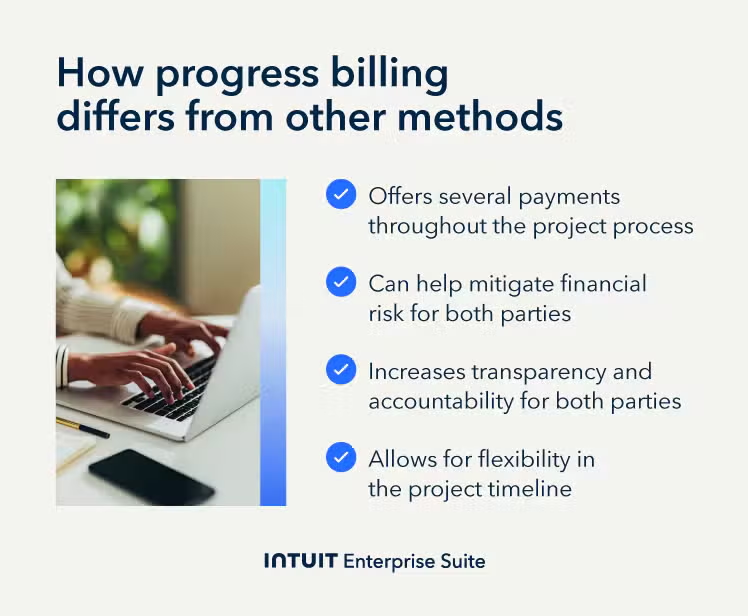
Progress billing is similar to advanced payments in that you collect payment upfront and not after a project. However, this invoicing method differs in that clients are invoiced at multiple stages of a project lifecycle instead of all at the beginning or all at the end. This helps clients have more communication and oversight of the project and helps the business collect payments from clients faster.
Critical components of a progress billing system include:
- Project breakdown includes milestone identification and assigning a percentage of the whole project to each milestone.
- Schedule of values is a specific breakdown of project costs, including labor, materials, and overhead.
- Progress tracking includes proper documentation and routine project progress tracking towards completion.
- Invoice generation includes calculating the amount due based on the percentage of work completed and the schedule of values.
- Payment terms include set payment schedules and percentage amounts and defining late fees, penalties, and potential legal action.
Industries where progress billing works well
Simply put, progress billing is most useful for projects that are complex, long-term, and/or require a significant amount of money upfront. Allowing payments to come in over time helps ensure that contractors receive the funds they need on time to complete the project’s next phase, which, for many large-scale ones, could take months or years.
Some industries that prefer project-based accounting over traditional methods of billing upon completion are:
- Construction and engineering
- Software development and IT projects
- Consulting services
- Manufacturing and production
- Creative industries (film, advertising, etc.)
Construction progress billing is especially common since it incentivizes timely completion and helps reduce the financial risk of nonpayment or delayed payments. Additionally, progress billing for construction helps give clients financial control and reduced upfront costs.
By receiving several payments throughout the project process instead of one lump sum at the end, the contractors will have adequate cash flow to continue working on this project without needing to use a line of credit.
Example of progress billing
Let’s assume that you are a construction company that is completing a new home build for a client. The total project cost is $800,000 and will take nine months to complete. Rather than charge the full project cost at the beginning or end of the project, you decide to implement a progress billing method as such:
- Month 1: Foundation and framing costs.
- Percentage of total project: 20%. Amount billed: $160,000.
- Total percentage of project billed: 20%.
- Month 2: No additional costs incurred.
- Month 3: Roofing and siding costs.
- Percentage of total project: 20%. Amount billed: $160,000.
- Total percentage of project billed: 40%.
- Month 4: No additional costs incurred.
- Month 5: Plumbing costs.
- Percentage of total project: 10%. Amount billed: $80,000.
- Total percentage of project billed: 50%
- Month 6: Electrical costs.
- Percentage of total project: 10%. Amount billed: $80,000.
- Total percentage of project billed: 60%
- Month 7: Drywall and insulation costs.
- Percentage of total project: 20%. Amount billed: $160,000.
- Total percentage of project billed: 80%
- Month 8: Flooring and painting costs.
- Percentage of total project: 10%. Amount billed: $80,000.
- Total percentage of project billed: 90%
- Month 9: Finishing touches.
- Percentage of total project: 10%. Amount billed: $80,000.
- Total percentage of project billed: 100%.
This method breaks down expected payments on a defined schedule, ensuring good cash flow during the entirety of the project life cycle.
How to implement a progress billing system
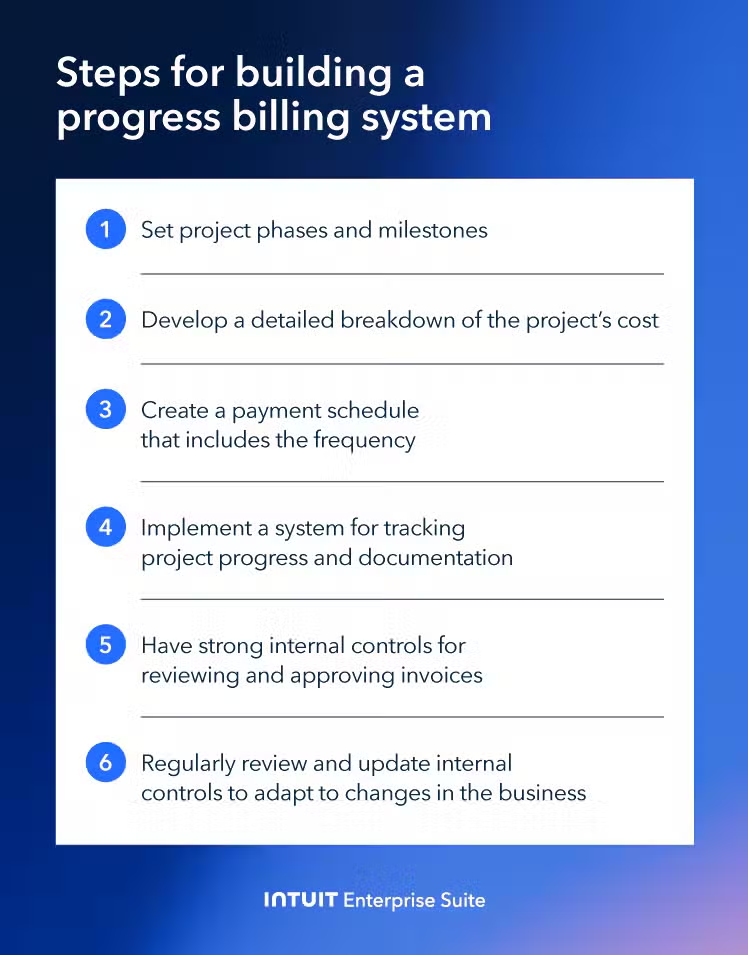
Identifying that your business should use progress billing is the first step, but now it’s time to put a progress billing system in place. Follow these steps to ensure a solid progress billing system for your business:
- Create a robust project timeline, dividing the project into clear milestones—for example, project initiation, project planning, and design and development.
- Develop a detailed schedule of values, assigning costs to each milestone. Be sure to include labor, materials, and overhead.
- Draft a comprehensive contract that details the project scope, milestones, and payment terms, including the percentage of completion required for each payment.
- Set up an efficient billing process using progress billing accounting software to automate progress billing and invoice generation.
- Implement a thorough review and approval system by tracking project progress updates and maintaining clear documentation.
- Establish effective payment collection procedures, including preparing clear invoices that detail the work completed and the corresponding costs.
Benefits of progress billing
Progress billing has many advantages over traditional billing upon completion, both for businesses and clients, making it a popular technique (and sometimes, the only billing method for certain industries).
Advantages for businesses
A business that uses progress billing has some key advantages, including:
- Improved cash flow management since money flows throughout the project instead of just at the end.
- Risk mitigation strategies include reducing the risk of nonpayment, delayed payment, or project delays.
- Enhanced project tracking capabilities since the payment schedule aligns with the project schedule.
- Strengthening client relationships by increasing transparency and communication.
Advantages for clients
Progress billing isn’t only beneficial for businesses—companies that use this method know that there are several advantages for their clients as well:
- Better budget management and financial planning due to a clear payment schedule. From an overarching standpoint, this keeps the client from going over budget and potentially allows them to invest more in ways they couldn’t have if payment were due upfront.
- Increased project transparency thanks to detailed project updates and invoices, which allows the client to see exactly where their money is going.
- Flexible payment schedule, in which clients can pay for a project over time rather than in one lump sum. This also helps clients not to pay for work that is not yet complete.
- Improved project oversight and control—since clients pay for a project piece by piece, they are privy to seeing the sum of its parts, allowing for oversight and course correction as needed.
Overcoming progress billing challenges
While many businesses choose to implement progress billing as a way to collect payments more quickly and efficiently than traditional methods, it can come with some challenges.
Some strategies to overcome potential progress billing obstacles:
- Create a detailed schedule of all-in costs and project timelines for accurate progress estimations, and monitor costs closely to ensure proper invoice tracking and billing.
- Make budgets flexible to account for unforeseen circumstances.
- Conduct regular reviews to assess project progress and change payment schedules or project plans as needed.
- Clearly define payment terms like due dates and late fees, including when they will be assigned.
- Keep detailed documentation, including photos, invoices, and progress reports.
- Consider dispute resolution methods like arbitration to resolve disputes with clients effectively.
- Establish and set a formal workflow for handling any changes in the scope of work or payment schedule.
Best practices for progress billing
Progress billing is a valuable tool for both businesses and clients, so it’s essential to instill some of the best practices for use. To help improve cash flow and make project management a breeze, take the following steps:
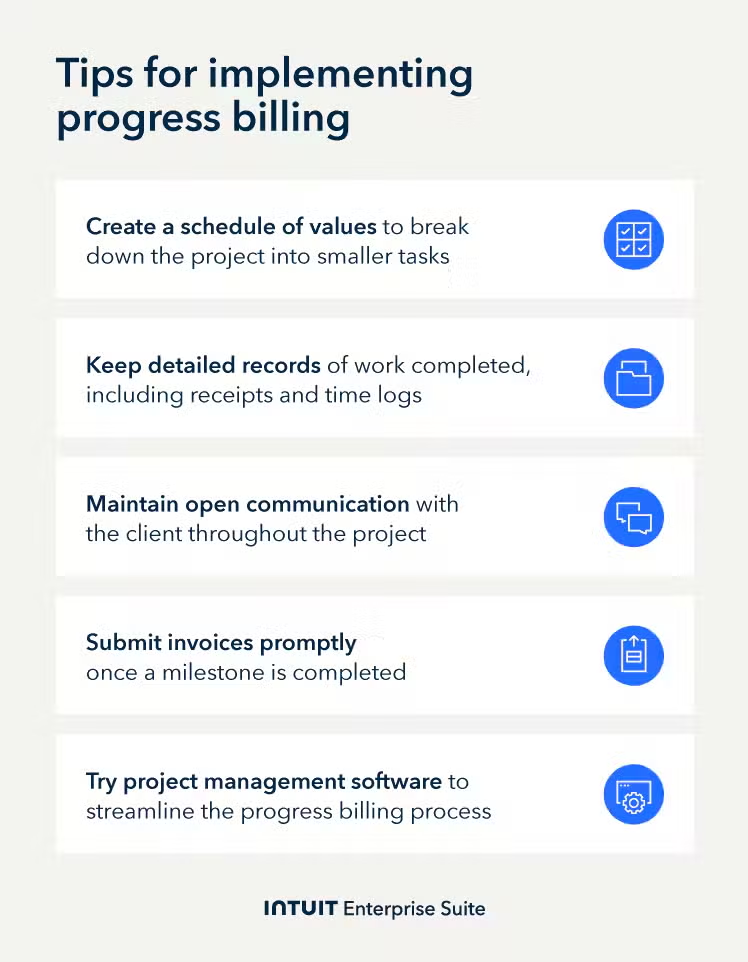
- Have span communication with clients. This includes clear communication on project scope and deadlines, payment schedule and amounts, and a straightforward change order process if needed.
- Keep accurate records, including invoices, photos of completed work, payments made, and any additional supporting documentation.
- Provide regular, detailed project status updates to keep communication open and expectations set.
- Leverage technology to streamline the billing process, like full-service accounting software that can automate invoice billing or a project management app to track milestones.
Boost productivity and enhance profitability
Integrating progress billing can help your business improve cash flow management and strengthen the relationship between you and your clients. Let Intuit Enterprise Suite help with this business solution to automate invoices and manage your cash flow, allowing you to get back to the project.
Progress billing FAQ
What are some appropriate milestones for progress billing?
While your specific progress billing milestone timeline may vary due to the complexity of the project and your particular business operations, the following are common milestones:
- Project initiation
- Project planning
- Design and development
- Quality assurance
- Deployment
- Project completion
What percentage of the total project cost should each progress payment represent?
While there’s no defined “rule,” there are some guidelines for specific industries on progress billing examples when representing a payment as part of the whole:
- General services: Progress payments are typically based on either time elapsed or the percentage of work completed and should range from 10% to 20% for each phase.
- Construction billing process: Progress payments are generally tied to specific milestones of work completed, ranging from 10% to 30% for each.
- Software development: Progress payments, ranging from 10% to 25%, are generally tied to the completion of specific phases.
What are the tax implications of progress billing versus billing upon completion?
There are some differences in filing taxes when it comes to progress billing versus billing upon completion:
- Income tax: With progress billing, you will need to pay income tax on the income you earn in the year it’s earned, even if you haven't physically received the payment yet. When you bill upon completion, you will not need to pay income tax until you have received the payment.
- Sales tax: Sales tax is due on each progress payment, whereas income tax is only due on the final payment when billing upon completion.
How does progress billing affect cash flow compared to other billing methods?
You have significantly improved cash flow with progress billing over other billing methods. With this strategy, you maintain regular income throughout the project cycle, giving you a steady stream of money to cover ongoing expenses without relying on credit.
What to do if a client fails to make a progress payment on time?
If a client fails to make a progress payment on time:
- First, communicate to them that the progress payment is late. Open communication is the first line of resolution.
- If no payment is made, review your contract to become well-versed on your rights and the client's obligations on payment and any associated fees.
- Send a formal reminder to the client, letting them know of the balance due and the past due date.
- If the client still defaults on the progress payments, consider meeting with a legal professional to discuss your options.
- Consider withholding work if and only if your contract allows for it until payment is received. However, this action might delay project deadlines and potentially result in legal action.