Connecting project and finance workflows across multi-entity professional services businesses

Key takeaways:
- Project delivery and financial reporting often run on separate systems, which creates reporting delays and manual reconciliation.
- Connected workflows reduce manual handoffs between project and delivery systems and financial reporting, so finance can work from more current operational and financial data.
- Intuit Enterprise Suite provides a connected multi-entity financial layer and integrates with the systems professional services firms use for delivery, helping finance scale without rebuilding reporting and reconciliation for every new legal entity.
Intuit's Future of Finance report found that for 7 in 10 finance leaders, business data is scattered across systems, spreadsheets, and static reports.
That problem only compounds in multi-entity professional services firms. As you add offices, entities, or an acquisition, project delivery data and the general ledger drift apart… and answering one question about performance can mean hours of reconciling disparate numbers by hand.
This article shows where multi-entity professional services financial workflows break down, what a connected model looks like, and how Intuit Enterprise Suite keeps project delivery and financial reporting in sync as you scale.
Why connected finance workflows matter for multi-entity professional services businesses
As a financial leader, what's really at stake for you is confidence: in the forecast, and in the numbers you put in front of executives and the board. When each entity closes on its own timeline and reconciliation is done by hand, one small mismatch can erode trust in the overall financial picture, right when leadership needs it most.
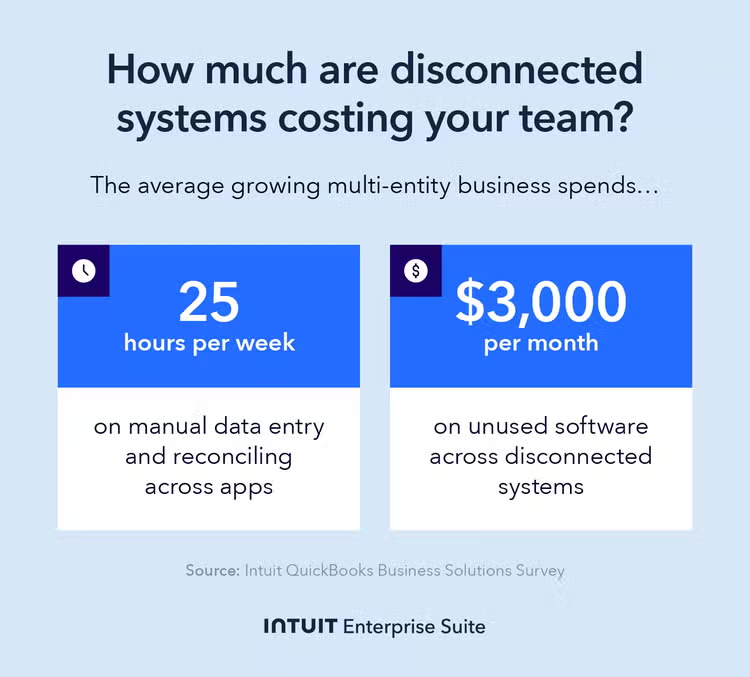
The bigger your firm gets, the more every disconnected system costs your finance team. Intuit's Business Solutions Survey puts manual data entry at 25 hours a week for growing businesses, which is time you could spend on forecasting and analysis instead of stitching numbers together.
The same survey found that 45% of respondents cite inadequate reporting and analysis capabilities as a direct challenge. In practice, that means reporting delays and inconsistent forecasts, with individual offices or service lines becoming harder to see clearly as more of them are added.
Where do project operations and finance become disconnected?
Businesses use an average of 10 different digital solutions to manage their operations, and 43% cite integration between those apps as a direct challenge. As you add offices, entities, or service lines, your project delivery tools and financial reporting often reside in systems that don't communicate with each other.
Almost all (98%) growing businesses say their digital solutions aren’t optimized to support growth. That lines up with what finance leaders describe at this point in growth: staffing data that doesn’t reach the general ledger, and project profitability that’s visible at the engagement level but disappears the moment someone tries to see it across the company as a whole.
A few breakdown points show up again and again as firms scale across entities:
What should connected, multi-entity finance workflows look like?
Fixing those breakdown points takes more than another spreadsheet or point solution. Your firm will need connected workflows in which project delivery and financial reporting share the same data, so visibility is built in from the start rather than pieced together later.
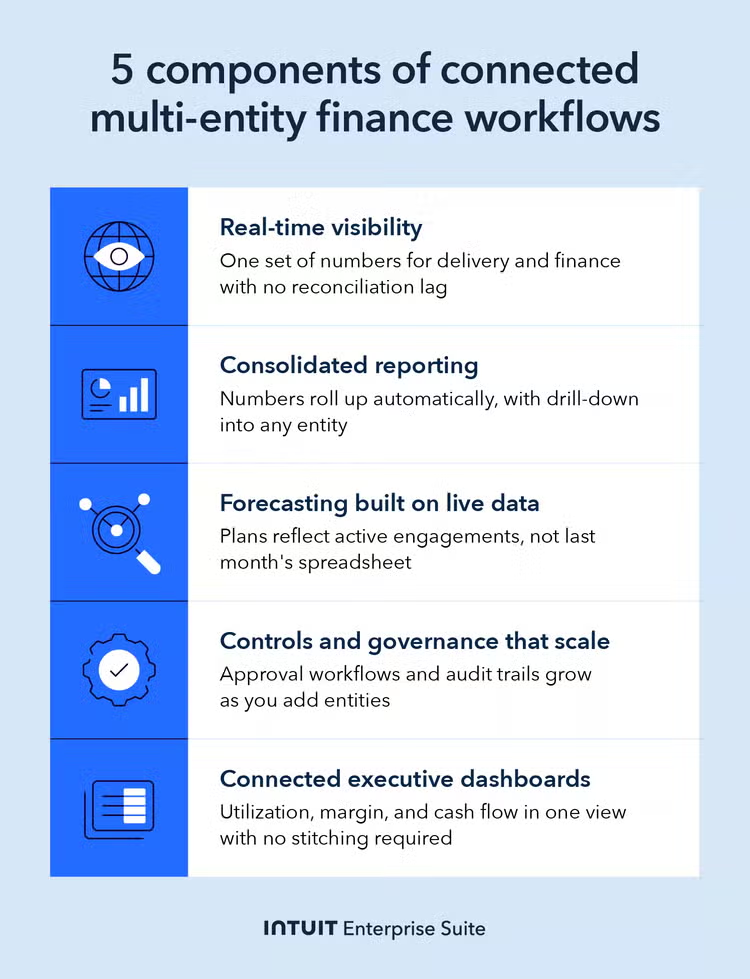
Here's what that looks like in practice:
Real-time visibility between project delivery and financial data
Real-time visibility means finance and delivery teams are looking at the same numbers at the same time, not reconciling two versions of the truth after the fact.
In a disconnected setup, information must travel via manual updates or a slow month-end close before it reaches the general ledger. As a result, a project manager might know a job is behind budget weeks before finance ever sees it reflected in a report. By the time finance flags the issue, the window to correct course has often already closed.
RedHammer, the largest construction-focused Client Accounting Services firm in the US, saw this shift firsthand while managing more than 135 entities on Intuit Enterprise Suite.
Now, leadership can see exactly how much cash is on hand and what liabilities are committed before a project drifts off track, rather than discovering it weeks later during a closeout.
Consolidated reporting across entities, offices, and service lines
Consolidated reporting lets you see how the whole business is performing without waiting for each entity to finish its close. The numbers roll up automatically into a single view, with the ability to drill back down into any single entity when something needs a closer look.
The Sylvia Brafman Mental Health Center saw this directly. Before adopting Intuit Enterprise Suite, the finance team relied on a separate third-party consolidation tool layered on top of multiple QuickBooks accounts, downloading roughly 20 CSV files per reporting period and reconciling them by hand.
Consolidated reporting replaced that tool entirely, giving CEO Jaime Blaustein a single multi-entity income statement.
Forecasting and resource planning built on current data
Forecasts are only as useful as the data behind them. When financial plans depend on spreadsheet snapshots from weeks earlier, the plan may already be out of date by the time finance acts on it.
Resource planning may remain in a specialized professional services system, depending on the operating model. What matters for your finance team is connecting the relevant operational inputs with current financial actuals, so staffing decisions and financial forecasts can be evaluated against the same business reality without treating them as the same workflow.
As current financial data changes, forecasts can be updated without rebuilding the model from static exports. That gives finance leaders a more current planning baseline while delivery teams keep the resource-planning tools that fit their workflow.
Controls and governance that scale as the business grows
Financial controls like approval workflows and audit trails have to scale with the business, not get bolted on after a handful of entities become dozens. Informal oversight that worked at one location breaks down as you add entities and offices. That's also where compliance risks creep in.
For RedHammer, this showed up directly in fund release approvals. With Intuit Enterprise Suite, even after a bill is posted to the general ledger, money doesn't move until it's authorized.
That approval step enforces a true segregation of duties, separating who enters a bill from who approves the payment, so no single person can push money out the door alone. It's a control that mid-market construction firms have historically struggled to implement without costly add-on systems.
Executive dashboards that connect operational and financial performance
Leadership shouldn't have to reconcile two separate reports to understand how the business is actually doing. A dashboard that shows utilization and project status without margin and cash flow tells only half the story, and the reverse is just as incomplete.
When delivery and financial metrics sit in a single connected view, a drop in utilization or a stalled project shows up alongside its financial impact immediately, rather than surfacing weeks later after someone stitches the two together by hand.
That connected view also changes how leadership makes decisions in the moment. An executive reviewing a financial reporting dashboard can see not just that a project is behind, but what that delay is costing, and not just that margin is down, but which office or service line is driving it.
How Intuit Enterprise Suite connects professional services finance workflows
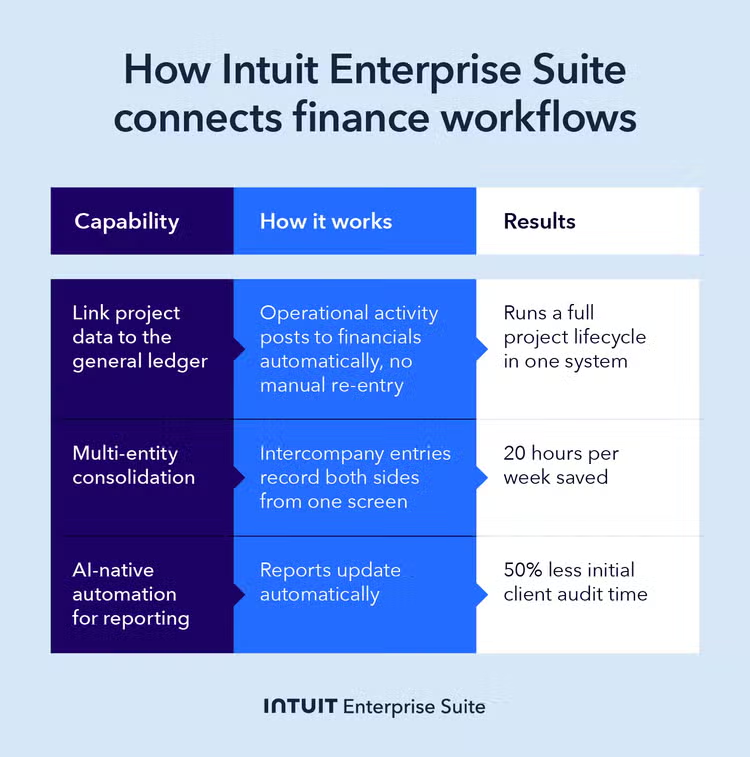
Intuit Enterprise Suite connects multi-entity financial management with the operational systems and data professional services firms rely on, helping finance reduce manual handoffs as the business scales.
Linking project and delivery data to the general ledger
Project and delivery data should connect cleanly to the financial system, whether the workflow runs in Intuit Enterprise Suite or a connected industry app. That reduces duplicate entry while giving finance a clear path from operational activity to the general ledger.
RedHammer put this into practice with Intuit Enterprise Suite. The firm manages its entire project lifecycle, from estimate to budget to invoice, in one system. Splitting the contract-level estimate from the internal budget lets the firm bill clients at a high level. Costs still get tracked underneath at a granular level. Both stay connected within the same system instead of drifting apart.
Multi-entity consolidation without manual reconciliation
Multi-entity consolidation should happen automatically, without teams reconciling each entity's books by hand.
Before adopting Intuit Enterprise Suite, the Sylvia Brafman Mental Health Center's finance team switched between separate company books and manually created matching journal entries on each side, the single largest source of month-end friction as the organization scaled.
With Intuit Enterprise Suite's Intercompany Journal Entries, one entry now records both sides of a cross-entity transaction from a single screen.
Once the team set up its due-to and due-from accounts through Intercompany Account Mapping, new entries flow to the correct balance sheet lines on their own, without anyone re-entering them by hand. The result? 20 hours saved per week on intercompany journal entries, and four or more disconnected financial tools replaced with a single platform.
AI-native automation for forecasting and reporting
Reports and forecasts should update as the underlying data changes, without waiting for a manual refresh cycle.
With the platform's Business Intelligence, RedHammer pushed proprietary report templates into new client files and eliminated weeks of manual data auditing, reducing initial client audit time by 50% and delivering strategic insights in days. That same automation keeps recurring reports and forecasts up to date as new transactions post, so the numbers you plan from reflect where the business stands today.
Questions finance leaders should ask when modernizing finance workflows
Modernizing a finance function starts with an honest look at where things stand today. These questions can help you identify exactly where workflows are disconnected, before deciding what to fix:
- Can we see project profitability at both the entity and consolidated level today? If the margin is only visible at one level but not the other, leadership is missing half the picture on which offices or service lines are actually performing.
- How long does it take to close the books across all entities? A slow or inconsistent close across entities is often the clearest sign that consolidation is still happening manually.
- Are our forecasts built on real-time data or last month’s spreadsheet? Forecasts built on stale exports are already out of date by the time anyone acts on them.
- Do our finance and delivery teams see the same numbers? If delivery and finance are working from different reports, someone is reconciling the gap by hand, and something is likely getting missed.
Building a finance function that scales with you
When project delivery and financial reporting share the same data, forecasting sharpens and consolidation stops depending on manual reconciliation, and you get numbers you can act on with confidence.
The next step is seeing a connected platform in practice. Intuit Enterprise Suite connects multi-entity financial management with the operational systems and data your firm relies on, while supporting consolidated reporting across entities. See how it fits your finance function.