Finance and controls: Guide on improving compliance

Effective finance and controls are key to strong financial management, helping your business maintain accuracy and full compliance. They serve as a crucial safeguard against financial risks and protecting your assets.
Whether you need to refine existing controls or implement new ones, a business management solution like Intuit Enterprise Suite can help streamline financial processes and improve overall business efficiency.
Let’s explore the different types of financial controls and best practices to enhance compliance and efficiency.
Understanding finance and controls
Financial control systems protect assets, enhance operational efficiency, and ensure compliance with financial regulations. These systems include policies, procedures, and tools that maintain financial integrity while minimizing risk.
Modern financial management solutions, such as enterprise resource planning (ERP) systems, can automate and streamline these processes. The key objectives of financial control systems include:
- Protecting assets: Safeguarding company resources from damage, fraud, misuse, and theft.
- Operational efficiency: Ensuring resources are used effectively to minimize waste and maximize productivity.
- Compliance: Adhering to relevant laws, regulations, and industry standards.
- Reliable financial reporting: Generating accurate financial information for decision-making.

Types of financial controls
Financial controls can be divided into three categories: preventive, detective, and corrective. Each plays a role in maintaining the integrity of financial processes and ensuring financial security.

Preventive controls
Preventive controls aim to stop errors or fraudulent activities before they happen. Examples include:
- Segregation of duties
- Approval and authorization processes
- Access restrictions to sensitive financial data
- Multi-factor authentication and password policies
- Employee training on ethical behavior and compliance
These controls help create a proactive defense against financial errors, fraud, and other risks by establishing barriers before issues arise.
Detective controls
Detective controls identify and detect financial errors or irregularities that have already occurred. Examples include:
- Reviews
- Reconciliations
- Automated alerts for unusual transactions
- Internal audits
- Analysis of financial accounting data
These measures help uncover potential issues early, allowing for timely correction and reducing the impact of financial discrepancies.
Intuit Enterprise Suite customers are saying
"[Intuit Enterprise Suite has been] a solution for the thing that we needed right away, which is a consolidation of information, the ability to look across our organization, and get that data in a format so we could move quickly."
Ed Sutton
Owner & CFO, MDR Realty LLC
Corrective Controls
Corrective controls resolve issues identified by detective controls to rectify problems and prevent recurrence. Examples include:
- Process improvements
- Disciplinary actions
- Financial restatements
- System updates or changes to enhance controls
These measures help ensure that identified issues are addressed effectively and similar problems do not arise in the future.
How to implement financial controls for compliance
Implementing financial controls requires a systematic approach to minimize financial risks and ensure compliance with regulations.
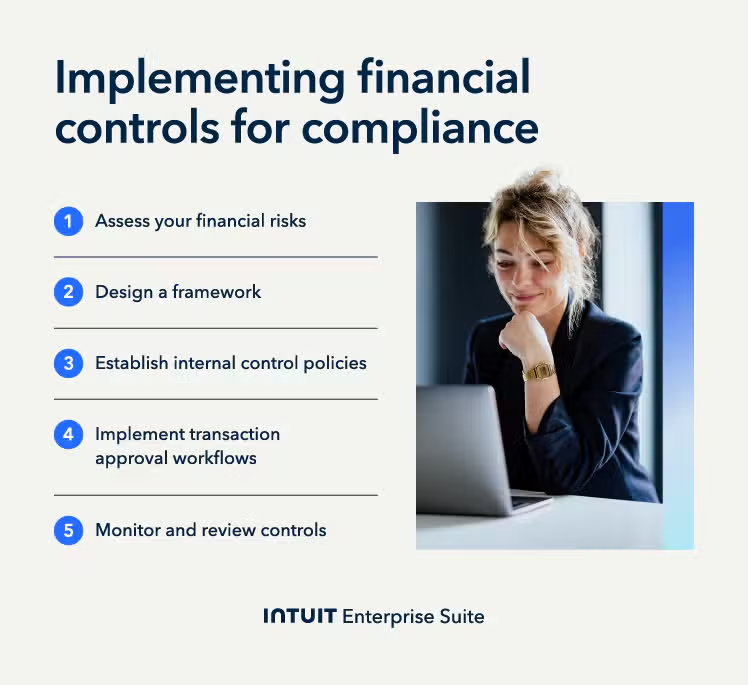
1. Assess your financial risks
Conduct a comprehensive risk assessment to identify potential financial risks, such as fraud, accounting errors, and compliance gaps, laying the foundation for an effective financial control system.
2. Design a financial control framework
Develop a structured approach that incorporates policies, procedures, and controls tailored to the organization's specific needs to ensure effective financial management and compliance.
3. Establishing internal control policies
Document clear guidelines for financial operations, including internal control policies that define responsibilities and procedures to ensure consistency and accountability. Proper employee training on these policies will help maintain a strong control framework across the organization.
4. Implement transaction approval workflows
Create workflows that mandate proper approvals for financial transactions to prevent unauthorized actions. Regularly review and update approval procedures to adapt to changing business needs and regulatory requirements.
5. Monitor and review controls
Review and monitor financial controls through internal auditing and review processes to assess their effectiveness. This oversight helps businesses identify potential inefficiencies in their financial systems, allowing for timely improvements and ensuring alignment with financial goals.
Examples of financial controls
Implementing strong financial controls helps businesses maintain accuracy, prevent fraud, and ensure compliance. Here are some key examples:
- Segregating accounts payable and receivable duties: Reducing the risk of fraud by ensuring that different employees handle these functions.
- Regular reconciliations: Comparing financial records to detect discrepancies and maintain accuracy.
- Internal and surprise audits: Conducting scheduled and unannounced audits to evaluate financial integrity.
- Budgeting and forecasting processes: Establishing financial plans to guide spending and investment decisions.
Adopting these financial control measures helps businesses minimize risks, improve efficiency, and establish a solid financial foundation.
Financial controls and compliance best practices
To safeguard financial health and maintain compliance, businesses should implement the following best practices:
- Establish and maintain a comprehensive internal controls program.
- Perform regular financial reporting and analysis.
- Implement robust fraud prevention measures.
- Regularly update and review financial policies and procedures.
- Provide regular training to employees on financial controls and compliance.
By implementing strong financial controls, businesses can enhance their enterprise value through improved operational efficiency and financial integrity.
Boost productivity and enhance profitability
Robust financial controls protect assets, enhance efficiency, and deliver actionable KPIs, enabling data-driven decisions that boost profitability and ensure long-term success.
A strong control framework shields assets and provides the reliable financial insights needed for strategic decision-making. Explore the Intuit Enterprise Suite today to transform your financial operations and strengthen your control environment.
Finance and controls FAQ
Key controls in finance are policies and procedures designed to ensure the accuracy, reliability, and integrity of financial reporting and operations.
These controls include:
- Segregation of duties: Making sure that no one individual has control over every aspect of a financial transaction.
- Authorization processes: Requiring approvals for significant financial activities.
- Documentation and record-keeping: Maintaining clear, accurate financial records.
- Reconciliations: Comparing financial records to identify discrepancies.
- Physical security: Protecting cash, inventory, and equipment from theft or misuse.
- Strong information security: Restricting access to financial systems and data.
- Compliance with regulations: Adhering to financial reporting and legal requirements.
- Active fraud prevention measures: Implementing internal audits and monitoring for suspicious activity.
- Risk assessments: Continuously evaluating and improving financial controls.
These controls provide reasonable assurance of financial integrity, efficiency, and protection against fraud and noncompliance in both finance and accounting operations.
Technology improves financial controls by automating processes to reduce manual error, enabling real-time monitoring to detect fraud and errors, and implementing secure access controls to prevent unauthorized transactions.
Advanced analytics help identify suspicious patterns, while automated audit trails and compliance monitoring ensure businesses meet regulatory requirements.
Segregation of duties is essential in financial controls, dividing key financial responsibilities among multiple individuals. By requiring different people to authorize transactions and record financial data, organizations create a system of checks and balances that minimizes the risk of unauthorized activities and fraud.
This control measure helps maintain regulatory compliance by ensuring proper oversight and transparency in financial reporting while strengthening internal controls and protecting organizations from financial misconduct.
Preventive controls are intended to prevent errors or fraudulent activities from occurring. Think of them as safeguards like segregation of duties, authorizations, and strong passwords.
Detective controls are reactive and aim to identify issues after they occur. Examples include audits, reconciliations, and monitoring systems. The core difference is their timing: Preventive controls act before an event, and detective controls act after.